GovCon Intelligence Brief – Issue No. 3

 

OpportunityHound by GovBid AI

GovCon Intelligence Brief

Week of April 27, 2026  |  Issue No. 3

The week federal acquisition turned the screws on cost discipline, with a six-day fuse on a $50B Army vehicle.

Executive Summary

The fourth week of April 2026 delivers a coordinated push toward acquisition discipline and contractor accountability. OMB issued M-26-12 on April 17, requiring agencies to review every non-commercial contract awarded since April 2025 and report results by May 4. The Federal Circuit ruled on April 15 that bid protesters challenging a CICA stay override need only show the override was arbitrary and capricious, removing the four-factor injunctive relief test. GAO published a NAVSEA labor cost report on April 14 documenting 60% labor cost overruns across reviewed task orders. The Army’s $50 billion MAPS solicitation is open with proposals due May 1, the Pentagon awarded Lockheed Martin a 10-year, $1.9 billion C-130J MATS IV IDIQ on April 14, and DOE on April 23 unveiled a 90-plus-company Nuclear Fuel Cycle Consortium. Industry events at Sea-Air-Space and Aberdeen APBI telegraphed FY2028 to FY2029 capability demand and faster Navy acquisition timelines, while SBA’s small business scorecard methodology change drew sharp congressional pushback.

In This Issue

01

Defend every non-commercial buy: OMB sets May 4 reporting deadline

02

Six days to bid: Army $50B MAPS proposals due May 1

03

Federal Circuit lowers the bar for challenging CICA stay overrides

04

GAO documents 60% labor cost overruns at NAVSEA professional services

05

Lockheed locks 10 years of C-130J training under $1.9B MATS IV IDIQ

06

DOE launches 90-company Nuclear Fuel Cycle Consortium with 60-day sprints

07

NAVAIR signals faster acquisition and direct industry engagement at Sea-Air-Space

08

APG APBI surfaces multi-billion FY2028 to FY2029 Army EW and CBRND forecast

09

SBA scorecard methodology change reshapes set-aside math for FY2026

10

DFARS Section 814 changes UCA profit math, hits April 17 implementation deadline

Top Developments

Development 01  |  Acquisition Policy

OMB M-26-12 Forces Agencies to Justify Every Non-Commercial Buy, Sets May 4 Reporting Deadline

On April 17, 2026, OMB Director Russell T. Vought issued memorandum M-26-12, “Increasing the Acquisition of Commercial Products and Services,” implementing Executive Order 14271. The memo directs federal agencies to give renewed priority to commercial products and services and to defend, in writing, any decision to pursue a non-commercial acquisition. OMB notes that more than two-thirds of total federal contract spending reported in FY 2024 was still classified as non-commercial, and singles out professional support, IT, telecommunications, and facilities operations as areas where commercial alternatives are routinely overlooked.

Agencies have until May 4, 2026 to report every non-commercial contract award from April 2025 through September 2025. Senior Procurement Executives must review recently awarded and in-process acquisitions and may request OMB input before pursuing a non-commercial acquisition. For contractors, the practical effect is twofold: bid-as-non-commercial contracts may face renewed scrutiny and re-scoping under FAR Part 12, and commercial item vendors gain a meaningful procurement preference, particularly in IT, professional services, and facilities. Capture teams should refresh commercial item determinations on every active pursuit and prepare to argue commercial classification in proposals where the agency has historically defaulted to non-commercial structures.

Source: OMB Memorandum M-26-12, April 17, 2026; Federal News Network, April 2026, “Agencies must defend decisions for not buying commercial items”; Washington Technology, April 2026, “OMB seeks details from agencies on their commercial buying”; Crowell & Moring, April 2026, IT transparency and acquisition oversight client alert.

Development 02  |  RFP Update

Army Opens $50B MAPS Bidding Window: Up to 350 Awards, Proposals Due May 1

The U.S. Army released the final solicitation for its Marketplace for Acquisition of Professional Services (MAPS) contract on April 1, 2026, opening a 30-day bidding window for one of the largest professional services vehicles in federal contracting history. MAPS (W15P7T26RA006) is a 10-year, $50 billion multiple-award IDIQ that consolidates RS3 and ITES-3S into a single mechanism for the Army, DoD agencies, and other federal entities to acquire knowledge-based professional services and IT services worldwide. Proposals are due no later than 5 p.m. Eastern time on May 1, 2026. Awards are anticipated by September 2026.

The Army is structured to make up to 70 awards per domain across five domains, broken out as 30 large business slots (with 15 reserved for Emerging Large Business), 25 small business slots, and 15 Commercial-Sector Vendor slots. Managed by ACC-APG, MAPS will be the Army’s principal vehicle for engineering, logistics, operational services, and foundational IT services for the next decade. The 25 small business slots per domain represent the most concentrated set-aside opportunity on a major DoD vehicle this year. With six days remaining as of publication, capture teams should be in final proposal review and color team posture, not solicitation analysis.

Source: Army Contracting Command-Aberdeen Proving Ground, MAPS Final RFP W15P7T26RA006, April 1, 2026; Washington Technology, April 2026, “Army launches $50B IT, professional services solicitation”; MeriTalk, April 2026; GovCon Wire, April 2026.

Development 03  |  Acquisition Policy

Federal Circuit Lowers the Bar for Challenging CICA Stay Overrides, Strengthening Bid Protest Rights

On April 15, 2026, the U.S. Court of Appeals for the Federal Circuit issued its decision in Life Science Logistics, LLC v. United States (No. 2024-1522), clarifying the legal standard for judicial review of agency overrides of automatic stays under the Competition in Contracting Act. The court held that a bid protester challenging a CICA stay override need only establish that the agency’s override was arbitrary and capricious under the Administrative Procedure Act. The court explicitly rejected the argument that protesters must satisfy the traditional four-factor test for preliminary injunctions, removing requirements to demonstrate likelihood of success on the underlying protest, irreparable harm, balance of hardships, and public interest.

The CICA automatic stay halts contract award or performance for up to 100 days while GAO resolves a protest. Agencies can override the stay on written findings of “best interests” or “urgent and compelling circumstances,” but the override is reviewable in the Court of Federal Claims. Before this ruling, protesters challenging an override had to mount a costly evidentiary case. After Life Science Logistics, protesters need only show the override decision itself was arbitrary and capricious. For incumbent contractors and subcontractors, this is a significant procedural win: agencies will face higher legal exposure for stay overrides, and protesters will gain leverage during the protest window.

Source: U.S. Court of Appeals for the Federal Circuit, Life Science Logistics, LLC v. United States, No. 2024-1522, April 15, 2026; National Law Review, April 2026; Crowell & Moring client alert, April 2026; PilieroMazza, April 2026 update.

Development 04  |  Agency Signal

GAO Documents 60% Labor Cost Overruns at NAVSEA Professional Services Task Orders

GAO publicly released report GAO-26-107889, “Navy Contracting: Sea Systems Command Actively Manages Labor Cost Increases for Professional Support Services,” on April 14, 2026. The report finds that NAVSEA, which spends billions annually on professional services, established a labor cost tracking system with a “tripwire” review when actual labor rates exceed 15% above estimated rates. GAO found that 106 of 389 ongoing task orders (27%) for fiscal years 2019 through 2024 triggered the tripwire review. Across 10 task orders that GAO reviewed in detail, actual labor costs increased by approximately $152 million as of April 2025, roughly a 60% increase from the labor cost estimates at the time of award.

GAO identified two common drivers: changes in NAVSEA’s underlying requirements during performance, and the use of higher-priced labor categories than originally estimated. The implications are significant. NAVSEA buyers (and other agencies that read GAO reports closely) will likely tighten labor category usage and scrutinize requirement changes that drive cost growth. Contractors performing on NAVSEA professional services task orders should expect more aggressive labor rate audits and contentious negotiations on requirement modifications. The report also gives ammunition to OMB and other oversight bodies pushing the broader commercial-buying agenda, since fixed-price commercial structures avoid the labor escalation pattern documented here.

Source: Government Accountability Office, GAO-26-107889, April 14, 2026, “Navy Contracting: Sea Systems Command Actively Manages Labor Cost Increases for Professional Support Services”; PilieroMazza, April 23, 2026, weekly update for government contractors.

Development 05  |  RFP Update

Pentagon Awards Lockheed Martin $1.9B Sole-Source IDIQ for C-130J MATS IV Training and Maintenance

On April 14, 2026, the U.S. Department of War (formerly Department of Defense) awarded Lockheed Martin a 10-year, sole-source, indefinite-delivery indefinite-quantity contract worth up to $1.9 billion to continue the C-130J Maintenance and Aircrew Training System (MATS) program. The C-130J MATS IV IDIQ enables the U.S. Air Force Life Cycle Management Center to continue providing aircrew and maintenance training devices, courseware, operations, interim and contractor logistics support, and engineering services for C-130J operators. Customers include U.S. Air Mobility Command, Air National Guard, Air Force Reserve Command, U.S. Marine Corps, Air Force Special Operations Command, Air Education and Training Command, plus newly added U.S. Navy Reserve and U.S. Coast Guard support.

For the broader contractor community, MATS IV is significant for two reasons. First, it locks in Lockheed Martin as the C-130J training and maintenance prime through the mid-2030s, foreclosing the prime competition opportunity but creating a substantial subcontracting pipeline for training device manufacturers, simulation software firms, courseware developers, and logistics service providers. Second, the sole-source structure will draw scrutiny under OMB M-26-12’s commercial buying push, since training services are a common commercial offering. Contractors with capabilities aligned to C-130J training and maintenance should immediately begin building relationships with Lockheed Martin’s MATS IV program office.

Source: Pentagon press release via news.lockheedmartin.com, April 14, 2026; GovCon Wire, April 2026, “Lockheed Secures $1.9B Air Force Contract for C-130J Training Systems Support”; Avitrader, April 20, 2026.

Development 06  |  Agency Signal

DOE Launches “Nuclear Dominance 3 by 33” with 90-Company Nuclear Fuel Cycle Consortium

On April 23, 2026, the U.S. Department of Energy’s Office of Nuclear Energy unveiled the Defense Production Act Nuclear Fuel Cycle Consortium at a public meeting in Washington. The consortium comprises representatives from more than 90 companies spanning the nuclear industrial base and will work to secure the U.S. nuclear fuel supply chain, addressing milling, conversion, enrichment, deconversion, fabrication, recycling, and reprocessing. The initiative is branded “Nuclear Dominance 3 by 33,” with three milestones by 2033: a secure and cost-competitive domestic fuel supply chain, accelerated advanced reactor deployment moving toward a closed fuel cycle, and full activation of the DPA framework.

The consortium will work in rapid 60-day “sprints” targeting near-term actions to cut U.S. reliance on foreign enriched uranium and critical materials. For contractors, the announcement signals a multi-year procurement and grant pipeline across DOE National Laboratories, the Office of Nuclear Energy, and the National Nuclear Security Administration, plus opportunities for DPA Title III investment instruments. Companies in nuclear fuel cycle services, advanced reactor design, uranium enrichment, materials handling, and waste management should monitor DOE’s DPA Title III solicitations over the next 60 days. The “sprint” framework suggests fast-cycle contracting actions that favor contractors who can stand up programs rapidly.

Source: U.S. Department of Energy Office of Nuclear Energy, April 23, 2026, “Department of Energy’s Defense Production Act Consortium Unveils New Initiative to Grow Nation’s Nuclear Fuel Cycle”; Mining.com, April 2026; ZeroHedge, April 2026; ExchangeMonitor, April 2026.

Development 07  |  Government Event

Sea-Air-Space 2026 Signals NAVAIR Acquisition Acceleration and Direct Industry Engagement

The Navy League of the United States held Sea-Air-Space 2026 from April 19 to 22 at the Gaylord National Resort & Convention Center in National Harbor, Maryland, drawing 430 exhibitors. NAVAIR Commander Vice Adm. John E. Dougherty IV used the opening day panel to telegraph an acquisition acceleration agenda, announcing the transition to Portfolio Acquisition Executive organizations designed to empower leaders to make data-driven trade-offs prioritizing time to field. Dougherty stated that great power competition demands faster performance and that contract negotiations “can take too long.” NAVAIR’s Rapid Capability Cell was emphasized as the mechanism for connecting warfighter requirements to industry partners earlier in the cycle.

NAVSUP, which awards more than 40% of Navy contracts, presented sessions on opportunities to work with NAVSUP, sourcing approach, and small business engagement. The combined messaging, faster acquisition timelines, expanded portfolio authorities, and direct invitation to small business participation, marks a meaningful shift in NAVAIR’s posture toward industry. Contractors with naval aviation capabilities, particularly small businesses, should engage NAVAIR’s Rapid Capability Cell and NAVSUP’s small business outreach now, rather than waiting for formal solicitations. Plan capture campaigns to take advantage of compressed timelines, less margin for typical six-month proposal cycles when NAVAIR is signaling 90-day expectations.

Source: NAVAIR.navy.mil, April 20, 2026, “Speeding Up Delivery With Industry Help”; Seapower magazine, April 2026; Southern Maryland Chronicle, April 23, 2026; Sea-Air-Space official program, April 19 to 22, 2026.

Development 08  |  Government Event

Aberdeen APBI Surfaces Multi-Billion FY2028 to FY2029 Army Forecast: P3I MA IDIQ Up to $2.4B

The Army hosted the 2026 Aberdeen Proving Ground Advance Planning Briefing to Industry (APBI) on April 21 and 22, 2026, in a hybrid format from APG, Maryland. Coordinated by Army Contracting Command-Aberdeen Proving Ground, the briefing provided industry visibility into FY2028 and FY2029 contracting opportunities aligned with APG’s mission areas, including Chemical, Biological, Radiological, and Nuclear Defense (CBRND), command and control systems, and electronic warfare. Disclosed forecast items included Pre-Planned Product Improvements (P3I) MA IDIQ valued at $1.6 billion to $2.4 billion, PM EW&C SETA Follow On at $200 million to $300 million, PM EW&C Future EWC Capabilities MA IDIQ at $800 million to $1 billion, PM C&S SETA Follow-on at $230 million to $270 million, and Modular Electromagnetic Spectrum System (MEMSS) at $67.9 million to $101.8 million.

The forecast provides a planning baseline for 18 to 24 month capture campaigns. Several SETA follow-ons typically retain incumbent advantage but face pressure under OMB M-26-12’s commercial buying mandate. Small businesses should target the smaller SETA follow-ons and CBRND specialty work. Companies pursuing larger MA IDIQs (P3I and EWC) should engage APG market research now, since 18-month capture cycles for these vehicles typically begin with industry days in the second half of FY2026. Contractors that did not attend should request the APBI presentation packages through the registration team. The forecast typically becomes the public baseline for capture planning across the next two budget cycles.

Source: GovTribe, April 2026, “2026 APBI Save the Date” listing; Sweetspot federal contracts platform, opportunity records for APG forecast IDIQs; Army.mil historical APBI archive; Federal News Network and event reporting.

Development 09  |  Small Business

SBA Small Business Scorecard Methodology Change Triggers Congressional Pushback

In March 2026, SBA Administrator Kelly Loeffler distributed a methodology change to the Small Business Procurement Scorecard, the annual instrument by which SBA grades each federal agency on small business contract performance. The new criteria emphasize contracting with veteran-owned firms, reduce sole-source 8(a) contract weight, rename the small disadvantaged business category to “economically disadvantaged” and broaden it to include veteran-owned firms, and add weight to fraud prevention and “competitive value to the taxpayer.” On April 1, 2026, House Small Business Committee Ranking Member Rep. Nydia Velazquez (D-N.Y.) sent SBA a letter raising 34 specific questions about the methodology and demanded a response by April 15. As of late April 2026, SBA had not responded.

The methodology change matters because the scorecard directly affects how agencies allocate set-aside contracts. Critics argue the new approach lets agencies receive easier “A” grades while reducing actual opportunities for women-owned small businesses, HUBZone firms, and traditional SDB-only firms. Veteran-owned firms (SDVOSBs and VOSBs) are likely to gain. The practical implication is that capture strategies must now account for the agency-level goaling decisions that flow from the new scorecard. Firms holding multiple certifications (e.g., SDVOSB plus 8(a) plus WOSB) gain optionality. Single-program 8(a) sole-source firms should expect reduced volume. HUBZone firms should expect reduced agency emphasis. Continuous enrollment certifications mean no fixed deadlines, but pursuit prioritization should reflect the new goaling math.

Source: Federal News Network, April 2026, “Is SBA moving the small business contracting goal posts?”; House Small Business Committee, Velazquez letter to Administrator Loeffler, April 1, 2026; SBA scorecard methodology document distributed March 2026; National Small Business Week 2026 announcements (April 6, 2026).

Development 10  |  FAR Change

DFARS Section 814 Rule on UCA Profit Calculation Hits April 17 Implementation Deadline

The FY 2026 National Defense Authorization Act, enacted in late 2025, imposed a 120-day window on DoD to amend the DFARS to implement Section 814, which adds two new categories of cost risk that must be included in profit calculations for undefinitized contractual actions. The implementation deadline fell on April 17, 2026. The two new cost risk categories are: (1) costs incurred prior to the award of a UCA, where those costs would have been directly chargeable if incurred after award and were incurred to meet anticipated delivery schedules or government price targets; and (2) costs arising from negotiations that exceed 180 days from a contractor’s submission of a qualifying definitization proposal. Section 814 amends 10 U.S.C. Section 3374(a).

The practical impact is that contractors performing on UCAs (a common structure for urgent or rapidly evolving DoD requirements) gain explicit protection for cost risks inherent in undefinitized work, including pre-award expenditures and prolonged definitization negotiations. Contracting officers must now factor these risks into profit determinations. Defense contractors should review active UCAs, document pre-award and pre-definitization investments, and prepare to argue increased profit during definitization. Companies should also track DoD’s published DFARS amendment to ensure consistency with the statutory text. Contractors should be prepared for the new framework to apply to UCAs entered after April 17, with potential retroactive applicability to in-process definitizations.

Source: Crowell & Moring, December 2025, “The FY 2026 National Defense Authorization Act”; Government Contracts Legal Forum, December 2025; Greenberg Traurig, February 2026; FY 2026 NDAA Section 814; 10 U.S.C. Section 3374(a).

Impact Analysis

This week’s developments converge around a single theme: federal acquisition is being pushed harder toward cost discipline, commercial alternatives, and faster delivery, while contractors gain new procedural leverage in protests but face heightened scrutiny on labor pricing and category management.

Business development pipeline. OMB M-26-12 forces a fundamental reconsideration of how requirements are scoped and bid. Capture teams should expect more requirements rewritten as commercial item buys, more pressure on FAR Part 12 framing, and more competition from commercial vendors. The Army MAPS solicitation provides a near-term test: at $50 billion across 10 years with up to 350 awards, MAPS will set the market clearing terms for Army professional services for a decade. Companies that miss May 1 face a multi-year wait.

Compliance and regulatory exposure. DFARS Section 814 implementation reshapes profit calculations on undefinitized work. The GAO NAVSEA labor cost report will accelerate agency tightening on labor category usage; expect more rigorous cost-realism reviews. The Federal Circuit’s CICA stay override decision shifts protest economics in favor of protesters, which will affect agency override decisions for the rest of 2026.

Small business positioning. SBA’s scorecard methodology change is consequential. Veteran-owned firms gain weight in agency goaling. WOSB, HUBZone, and 8(a) sole-source firms may see relative volume reductions. Multi-certification firms gain optionality. The 25 small business slots per domain on Army MAPS (up to 125 small business prime positions) represents the most concentrated small business prime opportunity on a major DoD vehicle in 2026.

Forward signals from industry events. APBI and Sea-Air-Space provided concrete forecast data points: $4-plus billion in disclosed APG forecast IDIQs for FY2028 to FY2029, plus NAVAIR’s stated commitment to compressed acquisition timelines. Companies in defense electronics, EW, naval aviation, and CBRND should accelerate capture campaign starts to align with disclosed forecast dates. Small businesses should specifically target the SETA follow-ons and specialty work where APG has historically used set-asides.

Recommended Actions

REFRESH COMMERCIAL ITEM DETERMINATIONS

OMB M-26-12 will ripple through agencies for the next 60 days as Senior Procurement Executives respond to the May 4 reporting deadline. Refresh FAR Part 12 commercial item arguments on every active and pipeline pursuit, particularly in IT, professional services, telecommunications, and facilities.

TREAT MAPS MAY 1 DEADLINE AS THE YEAR’S MOST CONSEQUENTIAL BID

With six days remaining as of publication and up to 350 awards on a 10-year, $50 billion vehicle, MAPS proposal teams should be in final color team posture, not strategy refinement. Small businesses face the most concentrated set-aside opportunity on a major DoD vehicle this year.

REVIEW LABOR CATEGORY USAGE AND UCA DOCUMENTATION

GAO’s NAVSEA report and the DFARS Section 814 implementation deadline together raise the stakes on labor cost discipline. Contractors performing on undefinitized contract actions should document pre-award costs and definitization negotiation timelines now.

RECALIBRATE SMALL BUSINESS CERTIFICATION STRATEGY

SBA’s scorecard methodology change will affect agency goaling for the rest of fiscal 2026. Multi-certification firms gain optionality and should reassess which certification flag to lead with on each pursuit. Single-program 8(a) sole-source firms should expand their pursuit base.

ENGAGE NAVAIR AND APG MARKET RESEARCH NOW

The Sea-Air-Space and APBI signals favor contractors that engage agency program offices early. NAVAIR is asking industry to bring problems and proposals proactively. APG has disclosed multi-billion-dollar forecast IDIQs in the FY2028 to FY2029 timeframe; capture campaigns should begin now.

OpportunityHound Spotlight

The week’s developments illustrate why opportunity intelligence has to look beyond the SAM.gov headline. The Army MAPS solicitation runs more than a thousand pages, with up to 350 award slots across five domains, and the most actionable details are scattered through attachments rather than the synopsis. OpportunityHound’s Advanced Search lets capture teams search inside the solicitation document text for the specific keywords and clauses that determine bid posture.

For tracking the broader policy and forecast picture, the Opportunity Watchlist sends real-time alerts on solicitation amendments, deadline extensions, and Q&A updates, which matter especially during compressed proposal windows like the six-day MAPS clock. And as APG and NAVAIR signal compressed acquisition timelines for FY2028 to FY2029 work, AI-Powered Filters help BD teams isolate opportunities by clearance level, page count, and key personnel requirements before capture investment.

Sign up free at oppyhound.com or book a demo to see how it works.

Forecast & Emerging Signals

OMB May 4 reporting deadline drives the next wave of commercial item reclassifications. Once agencies report their non-commercial buying patterns, expect a second OMB memo or class deviation in late May or June translating findings into specific contract restructuring directives.

Federal Circuit CICA stay decision will produce a wave of override challenges. The lower bar for protesters means more override challenges in the Court of Federal Claims through Q3 2026. Agencies will likely respond by issuing more conservative override findings.

DoD DFARS amendment for Section 814 expected publication by mid-May 2026. Contractors should monitor the Federal Register for formal DFARS publication. Implementing class deviation may precede formal rulemaking; UCA holders should review currently outstanding definitization actions for retroactive applicability.

APG forecast IDIQs likely to enter pre-solicitation phase in late summer 2026. The disclosed P3I MA IDIQ ($1.6B to $2.4B) and PM EW&C Future EWC Capabilities MA IDIQ ($800M to $1B) are likely to issue draft solicitations or industry days in Q4 FY2026.

DOE Nuclear Fuel Cycle Consortium will produce DPA Title III solicitations within 60 days. The “sprint” framework points to fast-cycle contract actions starting in May or June 2026. Companies in fuel cycle services should monitor DOE’s DPA Title III investment instrument announcements weekly.

SBA scorecard implementation will produce agency-level guidance over the next 90 days. Each agency’s response to the new scorecard methodology will shape its FY2026 set-aside decisions. SBA’s response to Velazquez’s 34 questions, if forthcoming, may also reshape the scorecard before final FY2026 grading.

Key Resources & References

The week’s developments reach across acquisition policy, large RFP activity, federal contract litigation, GAO oversight, and small business goaling. The resources below are the authoritative sources contractors should bookmark, monitor, and consult directly when developing capture and compliance strategies for the next 30 to 60 days.

OMB Memorandum M-26-12 (April 17, 2026)

Defines the May 4 reporting requirement and the Senior Procurement Executive review framework for non-commercial acquisitions.

Army MAPS Final RFP W15P7T26RA006 (April 1, 2026, SAM.gov)

Defines proposal due date (May 1, 2026), award structure, set-aside allocation, and evaluation criteria.

Federal Circuit Opinion in Life Science Logistics, LLC v. United States, No. 2024-1522 (April 15, 2026)

Establishes the new arbitrary-and-capricious standard for CICA stay override review.

GAO-26-107889 (April 14, 2026)

“Navy Contracting: Sea Systems Command Actively Manages Labor Cost Increases for Professional Support Services.”

DOE Office of Nuclear Energy, “Nuclear Dominance 3 by 33” Consortium Announcement (April 23, 2026)

Describes the consortium structure, sprint cadence, and 2033 milestones.

SBA Small Business Procurement Scorecard

Underlying scorecard framework and agency grading methodology.

NAVAIR Rapid Capability Cell

Engagement mechanism for proactive industry engagement on naval aviation requirements.

FY 2026 NDAA, Section 814, and 10 U.S.C. Section 3374(a) (Congress.gov)

Statutory text defining the new UCA profit framework.

Additional Recommended Reading

Agencies must defend decisions for not buying commercial items

Federal News Network, April 2026 — Walkthrough of M-26-12’s reporting requirements and the broader commercial item agenda.

Federal Circuit Holds Challengers to CICA Stay Overrides Need Not Satisfy Four-Factor Injunctive Relief Test

Crowell & Moring, April 2026 — Plain-English summary of the new CICA stay standard.

Is SBA moving the small business contracting goal posts?

Federal News Network, April 2026 — Reporting on the SBA scorecard methodology change and Velazquez letter.

Army launches $50B IT, professional services solicitation

Washington Technology, April 2026 — Detailed coverage of MAPS structure, customer set, and award allocation.

Speeding Up Delivery With Industry Help: NAVAIR Panelists Open Sea-Air-Space 2026

NAVAIR.navy.mil, April 20, 2026 — NAVAIR’s Sea-Air-Space messaging on portfolio acquisition executives, Rapid Capability Cell, and acquisition acceleration.

GovCon Intelligence Brief is published weekly by OpportunityHound, a GovBid AI publication.

Content is based on publicly available information from authoritative government, regulatory, and industry sources.

This brief does not constitute legal, financial, or procurement advice. Consult qualified professionals for guidance specific to your situation.

🔎 Sign up free at oppyhound.com

Feedback or unsubscribe: hello@govbidai.com

Week of April 27, 2026  |  Issue No. 3  |  © 2026 GovBid AI


GovCon Intelligence Brief – Issue No. 2


OpportunityHound by GovBid AI

GovCon Intelligence Brief

Week of April 20, 2026  |  Issue No. 2

The week the federal procurement playbook got rewritten: SBIR is back, enterprise software agreements are eating 120 traditional contracts at a time, and the FAR semiconductor comment window closes today.

Executive Summary

The third week of April 2026 delivers one of the most consequential sets of federal contracting developments of the year. Congress finalized the first major SBIR/STTR reauthorization in over a decade, restoring a $4 billion-per-year innovation pipeline. The U.S. Space Force awarded a $1.84 billion Andromeda IDIQ to 14 firms. The Court of Federal Claims cleared the VA’s $60.7 billion T4NG2 vehicle with a 33-vendor list. NASA is racing to extend SEWP V past its April 30 expiration because SEWP VI proposal evaluations are blocked by nine active GAO protests. OMB memo M-26-10 now requires agency CIOs to personally approve IT contracts and submit machine-readable utilization data. Meanwhile, the FAR semiconductor rule comment deadline is today (April 20), the DOL independent contractor rule comment deadline is April 28, and SBA continues aggressive restructuring of the 8(a) program with termination proceedings against 628 firms.

In This Issue

01

SBIR/STTR is back: 5-year reauthorization restores $4B annual innovation pipeline

02

Army-Anduril $20B enterprise agreement consolidates 120 procurement actions

03

Space Force awards $1.84B Andromeda IDIQ to 14 firms for orbital surveillance

04

Court clears VA T4NG2 $60.7B IT vehicle with 33 vendors to compete task orders

05

NASA extending SEWP V past April 30 as SEWP VI remains blocked by GAO protests

06

OMB M-26-10 requires CIO approval and machine-readable data on every IT contract

07

FAR semiconductor rule comment window closes today: supply chain visibility is the cost

08

SBA 8(a) terminations hit 628 firms as program narrows sharply under new guidance

09

SpaceX wins $178.5M SDA-4 task order for missile tracking satellite launches

10

DOL independent contractor rule comment closes April 28: narrower core-factor test

Top Developments

Development 01  |  Legislative Action

SBIR/STTR Reauthorization Becomes Law After Six-Month Lapse, Restores $4B Innovation Pipeline Through FY2031

After the SBIR and STTR programs lapsed on September 30, 2025, Congress finalized the most significant reauthorization in over a decade. The Senate passed S. 3971, the Small Business Innovation and Economic Security Act, by voice vote on March 3, 2026. The House approved it 345 to 41 on March 17, 2026. President Trump signed the legislation into law on April 13, 2026. The bill reauthorizes both programs through September 30, 2031, and extends required funding levels through fiscal year 2031, restoring roughly $4 billion in annual small business innovation funding across DoD, HHS/NIH, DOE, NASA, NSF, and other participating agencies. The approximately $6 billion measure also introduces new national security review requirements, a Strategic Breakthrough Allocation Program letting large-SBIR agencies fund up to $30 million awards for 48-month performance periods, and new per-firm proposal submission limits.

The six-month lapse had already disrupted solicitation cycles at multiple agencies. NIH issued NOT-OD-26-006 announcing the early expiration of several SBIR/STTR Notices of Funding Opportunity and providing guidance for existing recipients. With reauthorization now in force, contracting officers can resume Phase I and Phase II awards on a regular cadence, and innovation-focused small businesses should begin tracking the refreshed topic lists each agency is expected to publish over the next 60 to 90 days. The five-year runway gives small businesses predictability that has been missing since the program first lapsed in 2022.

Source: Congress.gov, S. 3971 and H.R. 3169 records (119th Congress); SBA press release, April 13, 2026, “Administrator Loeffler Applauds SBIR-STTR Reauthorization”; International Economic Development Council, April 1, 2026; Crowell & Moring, April 2026.

Development 02  |  Agency Signal

Army Awards Anduril $20B Enterprise Agreement, Copying and Extending the Palantir Model

On March 14, 2026, the U.S. Army awarded Anduril Industries a 10-year enterprise agreement worth up to $20 billion (five-year base plus five-year option) that consolidates more than 120 separate procurement actions into a single contracting vehicle. The structure mirrors the $10 billion Palantir enterprise service agreement the Army signed in August 2025, which rolled up 75 Palantir-related contracts (15 prime plus 60 related) into one ordering mechanism with pre-negotiated prices. An April 2, 2026 procurement analysis noted that these enterprise vehicles are likely to speed procurement but not without risk, flagging concerns about reduced competition, oversight challenges, and the precedent being set for venture-backed primes.

For the government contracting community, the enterprise agreement pattern is now established at the Army and spreading. It has three immediate implications. First, it consolidates incumbency: once a company is on an enterprise vehicle, the Army has strong incentive to buy through it rather than compete. Second, it elevates the strategic value of teaming and subcontracting on these vehicles, because prime access is increasingly locked. Third, it creates a procurement playbook other services and agencies are likely to copy, particularly for software platforms with broad user bases. Contractors should begin mapping their capabilities against the Anduril and Palantir vehicle scopes to identify where subcontract opportunities exist.

Source: Nextgov/FCW, March 2026; TechCrunch, March 14, 2026; Army.mil, July 31, 2025 Palantir ESA announcement; USSANews, April 2, 2026 enterprise vehicle risk analysis.

Development 03  |  RFP Update

Space Force Awards $1.84B Andromeda Space Domain Awareness IDIQ to 14 Firms, 10-Year Vehicle Open Through 2036

On April 7, 2026, the U.S. Space Force’s Space Systems Command awarded $1.843 billion in Andromeda program contracts to 14 companies to field next-generation space domain awareness and orbital surveillance capabilities. The awards are structured as firm-fixed-price indefinite-delivery, indefinite-quantity contracts running through April 8, 2036. The competition drew 32 offers and resulted in awards to a mix of traditional primes and non-traditional entrants: Anduril Industries, Lockheed Martin, Boeing’s Millennium Space Systems, Northrop Grumman, L3Harris Technologies, BAE Systems, Sierra Space, Redwire, General Atomics, Astranis Space Technologies, True Anomaly, Turion Space, Intuitive Machines, and Quantum Space. At the time of award, the Space Force obligated $1.4 million in research, development, test, and evaluation funding.

Andromeda is designed to acquire and field the next generation of space-based systems that track, identify, and analyze platforms on orbit, replacing the Geosynchronous Space Situational Awareness Program (GSSAP) capability over time. Task orders will be competed among the 14 awardees. Companies outside the vehicle should immediately begin identifying teaming and subcontracting opportunities with awardees. Space-focused small businesses should particularly target the non-traditional primes, which typically have more flexible supply chains and stronger appetite for smaller partner contributions.

Source: Space Force press release, Space Systems Command, April 2026; DefenseScoop, April 10, 2026; Defense Daily, April 2026; Via Satellite, April 9, 2026.

Development 04  |  RFP Update

Court of Federal Claims Clears VA’s $60.7B T4NG2 IT Vehicle, Finalizing 33-Vendor Award Pool

On April 3, 2026, Judge Molly R. Silfen of the U.S. Court of Federal Claims ruled that the Department of Veterans Affairs can proceed with T4NG2 (Transformation Twenty-One Total Technology Next Generation 2), the VA’s 10-year, $60.7 billion successor IT services vehicle. The ruling concluded what the court described as a “very large bid protest” and effectively finalized the VA’s list of 33 authorized vendors. T4NG2 is the primary contract the VA will use to acquire cybersecurity, systems engineering, software development, and electronic health record support services over the next decade. Certain protesters, including Taurian Consulting, Technatomy Corp., and Peregrine Digital Services, were added to the award pool during the litigation before the final decision.

With T4NG2 now cleared, the next phase is task order release. The VA is preparing to execute task orders against T4NG2 that cover cybersecurity modernization, EHR integration work with Accenture Federal Services, benefits system updates, and enterprise software support. For the 33 prime awardees, the focus turns to standing up capture teams and lining up subcontractors for the earliest task orders. For non-primes, the opportunity is subcontracting onto prime teams, particularly those with specialized cybersecurity or healthcare IT capabilities that the primes may not carry in-house.

Source: Stars and Stripes, April 3, 2026; Washington Technology, March 2026 T4NG2 protest coverage; U.S. Court of Federal Claims, April 2026 ruling.

Development 05  |  Agency Signal

NASA Races to Extend SEWP V Past April 30 Expiration, SEWP VI Blocked by Nine Active GAO Protests

NASA is on the verge of executing a modification to extend SEWP V, the $60 billion government-wide IT acquisition contract, past its April 30, 2026 expiration date. The current ordering period ends April 30 and the extension is expected to run through September 30, 2026. The need arose because SEWP VI, the $60 billion successor vehicle, cannot move to award while nine active GAO protests from companies whose proposals were rejected during Phase One of the evaluation process remain pending. GAO deadlines to rule on the protests fall in late May and early June 2026, well past the SEWP V end date.

For federal IT buyers and contractors selling IT hardware, software, and related services, the SEWP V extension is both reassurance and warning. Reassurance, because agencies can continue placing orders through SEWP V without a gap in contract authority. Warning, because the extension confirms SEWP VI is delayed indefinitely, and any capture strategy that depended on a mid-2026 award is now at risk. Contractors holding SEWP V positions should plan for an additional five months of order flow through the vehicle, and should prepare to adjust their SEWP VI positioning strategies as the GAO protest rulings come in.

Source: Nextgov/FCW, March 2026; Washington Technology, March 2026 nine GAO protests; NASA SEWP program office, April 2026 contract notices.

Development 06  |  Acquisition Policy

OMB Memo M-26-10 Requires Agency CIOs to Personally Approve IT Contracts, Submit Machine-Readable Utilization Data

On March 31, 2026, OMB issued memorandum M-26-10 on transparency, accountability, and oversight of federal technology, reinforcing FITARA (the Federal Information Technology Acquisition Reform Act of 2014) and significantly expanding the data agency CIOs must submit on IT purchases. Starting in May 2026, CIOs will begin submitting to OMB details about all contracts or other agreements for IT or IT services that they personally approve, plus contracts approved by a CIO delegee where those contracts directly enable or facilitate interaction between the public and the federal government through digital services. Agencies must also request information about their own utilization rates and prices paid for IT products and services, and must include provisions on future contracts to require that data to be disclosed to the government, including to other agencies, in a machine-readable format.

The operational impact on contractors is immediate. Federal IT buyers will be required to include new contract clauses mandating utilization and pricing transparency, and contractors will have to adjust their response processes to handle those new disclosures. Federal CIO Greg Barbaccia has publicly stated the goal is to ramp up enforcement of FITARA. The memo effectively ends the automated data collection approach used since the FITARA dashboard launched in 2009, requiring manual CIO-level submissions that could slow some IT contract approvals but increase visibility into shadow IT across agencies.

Source: OMB memorandum M-26-10, March 31, 2026; Federal News Network, April 2026; Nextgov/FCW, March 2026; Executive Gov, April 2026.

Development 07  |  FAR Change

FAR Semiconductor Prohibition Proposed Rule Comment Window Closes April 20: Contractors Face New Disclosure and Sourcing Obligations

The FAR Council’s proposed rule, “Federal Acquisition Regulation: Prohibition on Certain Semiconductor Products and Services,” published in the Federal Register on February 17, 2026, has a public comment deadline of April 20, 2026, the publication date of this brief. The rule would restrict federal acquisition of electronic products and services that incorporate certain semiconductor products, subsidiaries, or services, implementing statutory restrictions on procurement from designated foreign sources. If finalized in its current form, the rule will add new clauses requiring contractors to represent whether covered semiconductors are used in delivered items, to disclose supply chain information, and to refresh representations during contract performance.

The practical compliance burden will fall heaviest on IT, electronics, and telecommunications contractors whose products incorporate third-party semiconductor components. The rule structure parallels Section 889 (the Huawei/ZTE covered telecommunications prohibition), which required contractors to develop supply chain visibility into hardware embedded deep in their product offerings. Many contractors found Section 889 compliance far more expensive and time-consuming than initial estimates suggested. Today is the last day to submit public comments to shape the final rule. Responsive comments should focus on implementation timelines, subcontractor flow-down, and the scope of covered semiconductor categories.

Source: Federal Register, February 17, 2026; Wilson Sonsini, February 2026; Acquisition.gov, FAR Council open case docket.

Development 08  |  Small Business

SBA Initiates Termination Proceedings Against 628 Firms in 8(a) Program, Signals Materially Narrower Program Going Forward

On March 4, 2026, the Small Business Administration announced it had initiated termination proceedings against more than 620 firms in the 8(a) Business Development Program for refusing to produce three years of financial documents requested by the agency. That March 4 action followed an earlier move in February 2026, when SBA initiated termination proceedings against 154 Washington, D.C.-based 8(a) firms that failed to meet “economic disadvantage” eligibility requirements. In total, SBA suspended more than 1,000 firms during the winter for failing to respond to a December 2025 data call that required all 4,000-plus 8(a) participants to submit significant amounts of financial and eligibility documentation by January 19, 2026.

The enforcement campaign follows the January 22, 2026 SBA policy guidance that the agency will administer 8(a) on a strictly neutral basis, eliminating race-based presumptions of social disadvantage in response to the 2023 Eastern District of Tennessee ruling. The combined effect is a materially narrower 8(a) program. Only 65 new firms were admitted to the program in calendar year 2025. For currently certified 8(a) firms, the immediate action is document compliance. Any firm that has not responded to the data call should submit immediately or risk termination. Firms pursuing set-aside contracts under 8(a) should factor termination risk into teaming strategies and ensure that prime 8(a) partners are in good standing before committing to joint ventures.

Source: SBA press release, March 4, 2026; Holland & Knight, January 2026; Covington & Burling (Inside Government Contracts), January 2026; SBA announcement, January 22, 2026.

Development 09  |  Agency Signal

SpaceX Wins $178.5M SDA-4 Task Order Under NSSL Phase 3 Lane 1 to Launch Missile Tracking Satellites

On April 1, 2026, the U.S. Space Force awarded SpaceX a $178.5 million task order under the National Security Space Launch (NSSL) Phase 3 Lane 1 program to launch missile tracking satellites for the Space Development Agency. The contract, designated SDA-4, covers two Falcon 9 launches beginning in Q3 2027, one from Cape Canaveral Space Force Station in Florida, the other from Vandenberg Space Force Base in California. The satellites, built by Sierra Space, support the Space Development Agency’s missile threat detection and tracking mission from orbit. The award falls within the broader NSSL Phase 3 architecture, with Lane 2 firm-fixed-price indefinite-delivery contracts spanning five years (FY25–FY29) worth nearly $14 billion across Blue Origin, SpaceX, and United Launch Alliance.

For launch providers and the broader space sector, the SDA-4 award continues an important pattern: NSSL Phase 3 Lane 1 is active, being used for lower-cost missions and non-traditional pathways to orbit. Contractors supporting missile defense architecture (sensors, data analytics, ground operations, satellite integration) should align capture strategies with the Space Development Agency’s proliferated warfighter space architecture cadence. The Sierra Space satellites are part of a larger SDA constellation that will drive multiple task order releases over the next 18 to 24 months.

Source: Space Force press release, April 1, 2026; Space.com, April 2026; Teslarati, April 2026; SpaceNews archive, April 2025 NSSL Phase 3 framework coverage.

Development 10  |  Legislative Action

DOL Independent Contractor Rule Comment Period Closes April 28: Federal Contractors Face Narrower Core-Factor Test

The Department of Labor’s proposed rule on independent contractor classification, published in the Federal Register on February 27, 2026, has a public comment deadline of April 28, 2026. The rule would replace the 2024 Biden-era six-factor analysis with a streamlined approach centered on two “core” factors: the nature and degree of the worker’s control over the work, and the worker’s opportunity for profit or loss. The DOL has scheduled a public roundtable for April 9, 2026 through the SBA Office of Advocacy. Comments go to Docket ID WHD-2026-0001 on Regulations.gov. The rule would apply a single, uniform analysis under the Fair Labor Standards Act, the Family and Medical Leave Act, and the Migrant and Seasonal Agricultural Worker Protection Act.

For federal contractors, the rule carries two direct operational implications. First, many federal contractors rely heavily on 1099 subcontractors and independent consultants to staff proposals, technical reviews, and short-duration task order work. A narrower test that focuses on control and profit/loss opportunity will change which workers qualify as independent contractors versus employees. Second, the rule will interact with the Service Contract Act and Davis-Bacon Act wage determinations. Contractors should map their current 1099 workforce against the proposed two-factor test before the comment window closes.

Source: Federal Register, February 27, 2026; Jackson Lewis, March 2026; Mayer Brown, March 2026; SelfEmployed.com, March 2026.

Impact Analysis

Enterprise agreements and multi-award IDIQs are now the dominant model for large federal technology buys. The Anduril $20B enterprise agreement, Palantir $10B enterprise service agreement, Andromeda $1.84B IDIQ with 14 vendors, T4NG2 $60.7B with 33 vendors, and SEWP V/VI $60B ceiling collectively signal a structural shift in federal buying. Prime incumbency on these vehicles is now more valuable than ever, and the subcontracting market beneath them is correspondingly more important. Small businesses should prioritize teaming relationships with the primes on these vehicles over chasing standalone opportunities, and should target the non-traditional primes (Anduril, Sierra Space, Redwire, True Anomaly) whose supply chains are typically more accessible to smaller partners than traditional primes.

Small business programs are simultaneously expanding and contracting. Expansion comes from SBIR/STTR reauthorization, which restores a $4 billion annual pipeline across nearly a dozen agencies and gives small innovators five-year predictability through FY2031. Contraction comes from the SBA’s aggressive 8(a) program restructuring: 628 termination proceedings, only 65 new admissions in 2025, and a race-neutral administration standard that fundamentally changes eligibility. Small business contractors that historically relied on 8(a) set-asides should evaluate whether HUBZone, WOSB, SDVOSB, or SBIR/STTR pathways offer better positioning for their capabilities. The July 1, 2026 HUBZone map expirations for redesignated areas add another compliance trigger for firms using that vehicle.

Regulatory compliance burdens on federal contractors are intensifying on multiple fronts simultaneously. The FAR semiconductor rule (comment deadline today, April 20), the DOL independent contractor rule (comment deadline April 28), and OMB M-26-10’s CIO-level data submission requirements each impose new representation, disclosure, or data obligations. For small businesses in particular, the cumulative compliance burden is increasingly expensive relative to contract value, and companies should begin evaluating whether their compliance infrastructure can handle the incremental load without additional investment.

Space Force and space-focused procurement continue to be the most active high-growth sector. Andromeda ($1.84B) and SDA-4 ($178.5M) within two weeks of each other signal sustained procurement velocity, and the SDA’s proliferated architecture cadence means more task order releases are coming through 2027. Contractors outside the space sector may want to evaluate adjacent capability applications in space domain awareness, data analytics, satellite ground systems, and launch support services, because the addressable market is expanding faster than traditional defense segments.

Recommended Actions

SBIR/STTR-ELIGIBLE FIRMS

Monitor agency SBIR topic publications over the next 60 to 90 days. DoD, NIH, DOE, NASA, and NSF are likely to publish refreshed topic lists by early summer. Firms with prior Phase I or Phase II awards should verify status and explore Phase III commercialization pathways against the reauthorization’s updated provisions.

ARMY CAPTURE TEAMS (ANDURIL / PALANTIR)

Map your firm’s capabilities against the published scope of each enterprise vehicle. Identify two to three specific task categories where your firm can team with the prime or subcontract. Initiate outreach to prime business development contacts now, because early task order formation is where teaming partners are selected.

T4NG2 AWARDEES AND PURSUERS

The 33 prime awardees should stand up capture teams for the earliest task order releases, expected in Q2 2026. Non-primes should pursue teaming relationships now, targeting primes with gaps in specialized cybersecurity, healthcare IT, or EHR integration capabilities.

SEWP V INCUMBENTS

Plan for an additional five months of ordering activity through September 30, 2026. Monitor the formal extension execution, which NASA indicated is imminent. Begin preparing contingency plans if the SEWP VI GAO protest rulings in May and June 2026 result in further delays.

FAR SEMICONDUCTOR RULE COMMENTERS

Submit substantive comments on the FAR semiconductor rule today (April 20 deadline). Focus comments on implementation timelines, subcontractor flow-down, and scope definitions. Begin internal supply chain mapping of semiconductor components in delivered products regardless of final rule timing.

8(a) PROGRAM PARTICIPANTS

Verify your firm’s document submission status with the SBA. If the December 2025 data call request has not been fulfilled, submit immediately. Review eligibility under the January 22, 2026 race-neutral guidance and prepare updated social disadvantage documentation. Ensure any 8(a) prime partners in joint ventures are in good standing with SBA.

CONTRACTORS USING 1099 SUBCONTRACTORS

Map your current 1099 workforce against the proposed two-factor test (control and profit/loss opportunity) before the April 28 comment deadline. Submit comments that reflect federal contract execution realities. Evaluate whether any categories of workers might need to be reclassified as W-2 employees.

OpportunityHound Spotlight

Contractors navigating this week’s developments face a common challenge: the volume and velocity of federal procurement activity keeps accelerating while the analytical work to prioritize opportunities stays difficult. Five different buying vehicles ($20B Anduril, $10B Palantir, $1.84B Andromeda, $60.7B T4NG2, $60B SEWP V/VI), two federal rule comment deadlines (semiconductor April 20, independent contractor April 28), and a restructured 8(a) program with termination risk each require separate tracking, assessment, and response.

OpportunityHound’s Contract Opportunities search and filter helps BD and capture teams work this volume efficiently. The platform pulls directly from SAM.gov, lets you filter by NAICS, agency, set-aside type, and dollar threshold, and lets you save searches that alert you when new matching opportunities post. For firms targeting task order flow under T4NG2, Andromeda, or the enterprise agreements, the Contract Awards analysis feature shows historical award patterns, incumbent identification, and spending trends across agencies, supporting the competitive positioning work that comes after an RFP drops.

Companies building an 8(a), SBIR, or small business set-aside pipeline benefit from AI-Powered Filters that narrow results by page count, key personnel requirements, and clearance level, helping smaller firms find opportunities they can actually pursue without overcommitting resources.

Sign up free at oppyhound.com or book a demo to see how it works.

Forecast & Emerging Signals

Late April 2026. FAR semiconductor rule comment period closes April 20 (today). DOL independent contractor rule comment period closes April 28. OMB M-26-10 CIO data submissions begin in May 2026.

May–June 2026. GAO rules on nine active SEWP VI protests. The rulings will determine whether NASA can proceed with SEWP VI award, or whether further protest rounds delay the vehicle further. SEWP V extension execution expected imminently.

Q2 2026. T4NG2 task order releases begin after court clearance on April 3. First wave likely focuses on cybersecurity and EHR integration work.

Mid-2026. Agency SBIR/STTR topic lists expected to refresh under the new reauthorization. Watch for DoD, NIH, NASA, NSF, and DOE first-quarter topic publications.

July 1, 2026. HUBZone redesignated areas from the 2023 map update expire. Firms with principal offices in those areas must prepare for eligibility transitions.

Late Summer 2026. FAR semiconductor final rule publication expected if FAR Council maintains typical timeline after close of comment period.

Key Resources & References

Authoritative public sources supporting this week’s developments. Use for direct tracking of rulemaking dockets, contract vehicle information, and agency policy guidance.

Congress.gov, S. 3971 (119th Congress)

SBIR/STTR reauthorization legislation record.

Congress.gov, H.R. 3169 (119th Congress)

SBIR/STTR Reauthorization Act of 2025 companion bill record.

NIH NOT-OD-26-006

Notice of Early Expiration of NIH SBIR/STTR Notices of Funding Opportunity.

Army.mil, July 31, 2025 press release

Palantir Enterprise Service Agreement official announcement.

Federal Register, February 17, 2026

Proposed FAR Rule on semiconductor prohibition. Comment deadline April 20, 2026.

Federal Register, March 13, 2026

FAR Circular 2026-01.

SBA press release, March 4, 2026

8(a) program termination proceedings against 628 firms.

SBA announcement, January 22, 2026

8(a) race-neutral administration guidance.

NASA SEWP program

Official SEWP V and SEWP VI contract vehicle information.

Acquisition.gov FAR page

Current Federal Acquisition Regulation and open case docket.

Stars and Stripes, April 3, 2026

T4NG2 court ruling coverage.

Additional Recommended Reading

New OMB IT policy memo rings familiar, but signals major shifts

Federal News Network, April 2026. Analysis of how M-26-10 reshapes CIO authority and IT acquisition data oversight.

Space Force brings 14 vendors into $1.8B next-gen space domain awareness program

DefenseScoop, April 10, 2026. Detailed vendor list and contract structure for the Andromeda IDIQ.

DOL’s Proposed 2026 Independent Contractor Rule: What Employers Need to Know

Jackson Lewis, March 2026. Legal analysis of the two-core-factor framework and its comparison to prior rules.

SBA Issues Formal Guidance Regarding the 8(a) Program

Holland & Knight, January 2026. Comprehensive legal framing of the January 22, 2026 race-neutral guidance and its implications for current participants.

Proposed FAR Rule on Semiconductors: Will the Federal Government Buy Contractors’ Technology?

Wilson Sonsini, February 2026. Technology sector analysis of the semiconductor rule’s compliance and supply chain implications.

GovCon Intelligence Brief is published weekly by OpportunityHound, a GovBid AI publication.

Content is based on publicly available information from authoritative government, regulatory, and industry sources.

This brief does not constitute legal, financial, or procurement advice. Consult qualified professionals for guidance specific to your situation.

🔎 Sign up free at oppyhound.com

Feedback or unsubscribe: hello@govbidai.com

Week of April 20, 2026  |  Issue No. 2  |  © 2026 GovBid AI


CMMC 2.0 Assessment Guide: Process, C3PAO Requirements & Timelines

The Cybersecurity Maturity Model Certification 2.0 has become a pivotal requirement for companies in the U.S. Department of War, particularly those handling Controlled Unclassified Information (CUI) and sensitive federal data.

With major rule changes rolling out across 2025–2026, understanding the assessment process and the crucial role of Certified Third-Party Assessment Organizations (C3PAOs) is essential for winning DoW contracts and staying compliant.  

What is CMMC 2.0? 

CMMC 2.0 is a cybersecurity certification framework that ensures contractors meet minimum standards for protecting sensitive information. It has three levels:

  • Level 1 (Foundational) — self-assessment for basic cyber hygiene (applies to Federal Contract Information, FCI). 
  • Level 2 (Advanced) — based on the 110 controls in NIST SP 800-171 for organizations handling CUI; third-party assessments may be required. 
  • Level 3 (Expert) — highest level for critical systems and advanced threats, with government-led assessments.  

Starting November 10, 2025, most DoW solicitations will explicitly require CMMC compliance at these levels.  

For more info, please read: The Truth About CMMC 2.0 

CMMC 2.0 Assessment Types 

1. Self-Assessment 

Frequency: Annually
Applies To: 

  • All Level 1 contractors
  • Some Level 2 contractors handling non-critical CUI 

What It Involves 

Organizations conduct an internal review of their cybersecurity controls to ensure alignment with CMMC requirements and supporting NIST standards. 

Key steps include:

  • Developing and reviewing the System Security Plan (SSP)
  • Evaluating whether controls are fully, partially, or not implemented
  • Remediating critical gaps immediately
  • Documenting other gaps in a Plan of Action & Milestones (POA&M)
  • Submitting the score to SPRS
  • Senior official signs an annual compliance affirmation

How to Prepare 

  • Develop and maintain a complete and accurate SSP 
  • Conduct regular internal audits 
  • Ensure core practices (access control, authentication, logging, configuration management) are functioning properly 
  • Keep POA&M updated 


2. Third-Party Assessment (C3PAO) 

Frequency: Every 3 years
Applies To: 

  • Level 2 contractors handling prioritized / critical CUI

What It Involves 

An independent Certified Third-Party Assessment Organization  evaluates compliance with all 110 NIST SP 800-171 controls required for Level 2.

The review includes: 

  • Detailed examination of SSP and POA&M 
  • Policy and procedure review 
  • Interviews with personnel 
  • Technical validation (logs, configurations, vulnerability management, access controls) 
  • Evidence testing for control effectiveness 

After assessment: 

  • Preliminary findings may require remediation 
  • Final results are entered into eMASS and transmitted to SPRS 
  • Certification is valid for three years
  • Annual compliance affirmations are still required 

How to Prepare 

  • Strong documentation and repeatable processes 
  • Continuous monitoring and risk management 
  • Updated SSP and active POA&M 

3. Government-Led Assessment 

Frequency: Every 3 years
Applies To: 

  • Level 3 contractors handling highly sensitive DoW information

What It Involves 

Led by DoW assessors (typically through DIBCAC), this is the most rigorous assessment level.

It evaluates: 

  • All NIST SP 800-171 controls
  • Additional enhanced controls from NIST SP 800-172

The process includes: 

  • Pre-assessment coordination 
  • On-site interviews and technical testing 
  • Evidence validation (logs, configurations, incident response capabilities) 
  • Entry of results into eMASS and SPRS 
  • Final certification valid for three years
  • Annual affirmations required 

How to Prepare 

  • Mature cybersecurity program 
  • Advanced threat detection and response capabilities 
  • Continuous monitoring 
  • Fully documented and actively maintained SSP and POA&M 

CMMC Level 2 Assessment Process  

The official CMMC assessment process (often guided by the CMMC Assessment Processframework contains four general phases. These phases apply to third-party assessments performed by C3PAOs for Level 2 certification.

  1. Prepare & Plan
  • Define the scope and boundaries of the assessment (what systems/processes are in scope). 
  • Conduct internal readiness reviews and gather documentation such as the System Security Plan, evidence of control implementation, policies, and procedures.
  • Review NIST SP 800-171 controls and assess your gap against required practices. 
  • Pre-assessment discussions with the C3PAO help confirm readiness to proceed.  
  1. Conduct the Assessment

During the formal assessment, the C3PAO team (including Certified CMMC Assessors) evaluates your implementation of the required controls, typically by: 

  • Interviewing staff and stakeholders. 
  • Reviewing documentation, configurations, logs, and security evidence. 
  • Observing system practices and configurations in real time.

This phase verifies that your security program satisfies the 110 NIST SP 800-171 control objectives relevant to Level 2.  

  1. Report Findings

The assessors compile a detailed report listing about which practices are metnot met, or not applicable, and assign scores accordingly. The report may include required remediation actions (via a Plan of Action & Milestones) if some controls are deficient.

  1. Certification, Closure & POA&M Work

Once all gaps are addressed and verified, the C3PAO issues a Final or Conditional Level 2 certification. Contractors upload evidence and certification results into required DoW systems for contract eligibility.

Tip: Some organizations schedule mock assessments with their chosen C3PAO months before the formal audit to reduce surprises on audit day.  

Level 2 Typical Timelines 

Achieving CMMC Level 2 certification readiness generally takes 6–18+ months, influenced by your starting cybersecurity posture, documentation maturity, and size of the environment.  

Here’s what recent analyses show: 

Phase  Typical Duration 
Gap analysis & remediation preparation  ~2–6 months 
Documentation & training  ~1–2 months 
Scheduling C3PAO assessment  ~8–12 weeks 
Formal assessment process  ~1–2 weeks 
POA&M closure (if needed)  2–6 weeks 

In practice, many organizations budget 12–18 months from initial readiness work to formal certification — with larger enterprises pushing toward the higher end of that range. 

Why C3PAOs Are Critical to Compliance 

C3PAOs are authorized, independent assessors accredited to evaluate and certify an organization’s compliance for CMMC Level 2 when required. Without a C3PAO assessment (when mandated), your organization cannot be officially certified and may be disqualified from certain DoW contracts. 

What C3PAOs Do 

  • Validate your cybersecurity posture against CMMC criteria. 
  • Conduct formal assessments (as outlined above). 
  • Issue final certification decisions that support DoW contract eligibility. 
  • Provide assessment documentation required by DoW reporting systems.  

Becoming a C3PAO involves rigorous qualification, vetting by the Cybersecurity Maturity Model Certification Accreditation Body, background checks, quality assurance requirements, and ongoing oversight.  

When is a C3PAO Required? 

A third-party assessment is typically mandated when: 

  • You handle CUI that falls within the DoW’s registry requirements. 
  • Your contract is designated as high-risk or requires certified Level 2 status. 

Some Level 2 contracts do allow self-assessment (with senior official affirmation), but this is the exception rather than the rule for sensitive data handling. 

Common Pitfalls & Best Practices 

  • Underestimating documentation needs: Complete, consistent SSPs and evidence are critical. 
  • Starting late: Scheduling C3PAO assessments often happens months in advance due to demand. 
  • Neglecting scope definition: Inaccurate scoping causes delays during actual assessment. 
  • Ignoring mock assessments: Practice audits reduce the risk of failed assessments.

Pro tip: Partner early with a Registered Practitioner Organization (RPO) for preparation but remember, C3PAOs cannot consult and then assess the same organization to maintain independence.

Recent oversight audits by the DoW Inspector General have raised concerns about gaps in how C3PAOs are authorized and vetted, with implications for certification reliability and compliance risk. This underscores the importance of ensuring your assessor is fully accredited and compliant with CMMC standards.

Final Takeaways 

CMMC 2.0 compliance is no longer optional.  Level 2 certification will be a contractual requirement for many DoW opportunities starting now.  

The assessment process follows a structured, multi-phase path with rigorous evaluation of controls, documentation, and evidence. C3PAOs are essential partners in achieving formal certification when required, serving as neutral arbiters of your cybersecurity maturity.

Whether you’re preparing for your first assessment or refining your compliance strategy, understanding the CMMC 2.0 framework and the role of C3PAOs will make the difference in winning DoW contracts and strengthening your cybersecurity posture.

FAQs

1. What is the difference between a self-assessment and C3PAO assessment?

self-assessment is conducted internally and applies to Level 1 contractors and some Level 2 contractors handling non-critical CUI. Organizations review their own controls and submit results to SPRS annually. 

A C3PAO assessment, required for Level 2 contractors handling prioritized CUI, is conducted by an independent Certified Third-Party Assessment Organization. It involves a formal review of documentation, interviews, technical validation, and evidence testing. Certification is valid for three years.

2. When is a C3PAO required for CMMC Level 2? 

A C3PAO is required when a contractor handles prioritized or critical CUI and the DoW contract specifies third-party certification. Some Level 2 contractors may be eligible for self-assessment, but many contracts will require independent certification to ensure higher assurance. 

Always verify the CMMC level requirement listed in your solicitation. 

3. What happens if we fail a CMMC assessment?

If controls are partially implemented or missing, the C3PAO will issue preliminary findings. 

Organizations may: 

  • Remediate deficiencies within an approved POA&M (if eligible) 
  • Undergo additional validation 
  • In some cases, schedule a reassessment 

Failure to achieve certification can impact eligibility for DoW contracts that require a specific CMMC level. 

4. Can a consultant both prepare us and conduct the CMMC assessment? 

No. To maintain independence and avoid conflicts of interest, a C3PAO cannot both consult and assess the same organization. 

You may work with a Registered Practitioner Organization (RPO) for readiness preparation, but your formal certification must be performed by a separate authorized C3PAO. 

5. Where are CMMC assessment results submitted? 

Assessment results are entered into: 

  • SPRS (Supplier Performance Risk System) for scoring and affirmations 
  • eMASS for Level 2 and Level 3 certifications 

These systems allow the DoW to evaluate contractor risk before awarding contracts. 

What is a Contract Opportunity Platform and How is AI Changing Government Contracting

Government contracting has never been short on opportunities, but it has always been short on clarity. 

Every year, thousands of solicitations are released across federal, state, and local portals. RFPs run into hundreds of pages. Amendments arrive mid-cycle. Deadlines shift. And teams are expected to identify the right opportunities, analyze them fast, stay compliant, and respond, all while competing with well-resourced incumbents. 

This is where AI-powered contract opportunity platforms are changing the game. 

In 2026, success in government contracting no longer depends on who can search harder; it depends on who can search smarter, analyze deeper, and act faster. 

The Problem with Traditional Contract Discovery 

Most contractors still rely on a fragmented approach: 

  • Manually checking multiple procurement portals 
  • Keyword-based searches that surface irrelevant bids 
  • Spreadsheet tracking for deadlines and amendments 
  • Hours spent skimming RFP PDFs just to assess fit 

The result is missed opportunities, late responses, low bid or no bid confidence, and wasted effort on contracts they were never likely to win 

As procurement volumes increase and competition intensifies, this approach simply doesn’t scale. 

What Is a Contract Opportunity Platform? 

A modern contract opportunity platform centralizes the entire pre-award process from discovery to analysis using AI and automation. 

Instead of chasing solicitations, contractors receive: 

  • Relevant opportunities matched to their capabilities 
  • Structured insights from unstructured RFP documents 
  • Real-time alerts when something changes 
  • Data-driven clarity to make faster bid decisions 

The Rise of AI in Government Contracting 

AI is no longer experimental in GovCon. It’s already transforming how teams operate across three critical areas: 

  1. Opportunity Discovery at Scale

AI can scan thousands of solicitations across portals and sources, identifying patterns and relevance that keyword searches miss. This means fewer false positives and more qualified opportunities to enter the pipeline. 

  1. RFP & Document Intelligence

RFPs are dense, repetitive, and complex. AI-powered document intelligence can: 

  • Extract key requirements 
  • Identify compliance sections 
  • Surface risks and red flags 
  • Summarize scope, timelines, and evaluation criteria 

What once took several hours can now be done in minutes, without sacrificing accuracy. 

  1. Smarter Bid Decisions

With structured insights from unstructured data, teams can confidently answer: 

  • Is this opportunity aligned with our capabilities? 
  • Do we meet mandatory requirements? 
  • Is effort worth the potential value? 

This is where win rates improve, not because teams bid more, but because they bid better. 

Why Most AI Tools Still Fall Short 

Despite the buzz, many AI tools struggle in real GovCon environments because they: 

  • Aren’t built specifically for government procurement 
  • Lack deep domain understanding 
  • Overpromise automation without accountability 
  • Are priced beyond the reach of small and mid-sized contractors 

Government contracting requires precision, context, and trust, not generic AI outputs. 

That’s exactly the gap OppyHound was built to solve. 

Why OppyHound Is Emerging as a Modern Contract Opportunity Platform 

Basic Search: Simple, Fast, and Powerful

Note: The OppyHound interface is continuously evolving. The screenshots included in this blog may not reflect the most recent updates.

OppyHound isn’t just another AI tool; it’s a purpose-built platform designed by government procurement experts, for teams that need real results without enterprise-level complexity or cost. 

Here’s what sets it apart. 

  1. Opportunity Discovery: Finding the Right Contracts, Not Just More Contracts 

Traditional contract discovery relies heavily on: 

  • Manual searches across multiple government websites  
  • Rigid keyword filters 
  • Reading government documents 
  • Static alerts that don’t understand context 

This approach floods teams with irrelevant opportunities and forces them to sift through noise just to find a handful of viable bids. 

A modern contract opportunity platform changes this by using AI-driven discovery. 

Instead of asking “What contracts exist?” the platform answers: 

  • Which opportunities are relevant to my capabilities? 
  • Which solicitations are worth reviewing right now? 
  • Which contracts align with my size, core capabilities, customer set, and experience? 

OppyHound’s Opportunity Discovery engine continuously scans and surfaces solicitations that match your business profile. 

The outcome: 

  • Fewer false positives 
  • A cleaner, more qualified pipeline 
  • Less time searching, more time deciding 
  1. AI-Powered Document Intelligence: Turning RFP Chaos into Clarity

Government solicitations are notoriously difficult to work with: 

  • Hundreds of pages 
  • Dense legal language 
  • Buried compliance requirements 
  • Multiple amendments and attachments 

Manually reviewing these documents is slow, error-prone, and mentally exhausting. 

This is where AI-powered document intelligence becomes mission-critical. 

A modern platform doesn’t just store documents; it understands them. 

OppyHound’s AI-powered document intelligence enables teams to: 

  • Extract key requirements, deadlines, and evaluation criteria 
  • Identify mandatory compliance items and red flags 
  • Summarize scope, deliverables, and submission instructions 

Instead of spending hours reading, teams spend minutes understanding. 

This dramatically improves early-stage bid/no-bid decisions and reduces downstream proposal risk. 

  1. Structured Analysis & Deep-Dive Reporting: Insight at Every Level

One of the biggest challenges in GovCon teams is misalignment: 

  • Executives want high-level summaries 
  • Capture managers want strategic insight 
  • Proposal teams need granular detail 

A modern contract opportunity platform must serve all three without forcing users to dig through raw documents. 

OppyHound solves this through comprehensive AI-generated reports with deep-dive capability. 

These reports: 

  • Provide a clear, executive-level overview of the opportunity 
  • Break down requirements, timelines, and evaluation logic 
  • Allow users to drill into specific sections when needed 
  • Create a shared source of truth across teams 

This ensures everyone is working from the same intelligence, just at different levels of depth. 

  1. Real-Time Opportunity Monitoring: Staying Ahead of Change

Government solicitations are rarely static. 

Amendments, Q&A releases, scope clarifications, and deadline extensions are common and missing even one update can derail an otherwise strong proposal. 

A modern contract opportunity platform must actively monitor opportunities after discovery, not just surface them once. 

OppyHound provides real-time opportunity monitoring, ensuring that: 

  • Any changes to a solicitation are detected immediately 
  • Teams receive instant alerts 
  • No amendment or update slips through the cracks 
  • Proposal managers and teams can quickly assess amendments for changes and understand government’s answers to industry questions.   

This removes constant manual checking that drains time and attention and replaces it with confidence. 

  1. Watchlists & Workflow Control: From Reactive to Proactive

Winning teams don’t wait for deadlines to approach, they prepare early. 

A modern platform enables proactive planning through Watchlists. 

With OppyHound, teams can: 

  • Add key solicitations to a Watchlist 
  • Track high-priority opportunities over time 
  • Monitor changes, deadlines, and readiness 
  • Align internal stakeholders and teammates around the same targets 

This turns opportunity management into a structured workflow rather than a last-minute scramble. 

Why OppyHound Sets the Benchmark 

Many tools claim to “use AI.” Few are built specifically for government procurement realities. OppyHound stands out because it is: 

  • Built by government procurement experts, not AI engineers / developers 
  • Designed around real GovCon workflows 
  • Focused on clarity, accuracy, and trust 
  • Priced to be accessible for startups, not just enterprise-only 

With features like Opportunity Discovery, AI Powered Document Intelligence, Deep Dive analysis at a budget friendly pricing, OppyHound doesn’t just help you find opportunities it helps you understand them, prioritize them, and act on them faster than your competitors. 

Next Step 

Government contracting is only getting more competitive. Opportunities are abundant, but the advantage belongs to teams that can find the right contracts early, understand them quickly, and act with confidence. OppyHound gives you exactly that advantage. 

You can sign up for free and start exploring contract opportunities right away. When you’re ready to go deeper, upgrading to a paid plan unlocks the real power of OppyHound, starting at just $25 per month. 

If winning more government contracts matters to your business, the next step is simple. 

Sign up for free today. Upgrade when you’re ready. Start competing smarter with OppyHound. 

10 High-Value Defense Contracts Up for Bid in 2026

Every fiscal year, the U.S. Department of Defense (DoD) puts billions of dollars into the federal contracting marketplace. Many of these opportunities are evergreen contracts, they come up for rebid on a predictable cycle.

If your business is serious about growing in government contracting (GovCon), knowing which high-value defense contracts will be open in 2026 can give you a head start on capture planning.

Unlike one-off projects, these contracts follow consistent timelines. Agencies typically give at least 30 days to respond, and most solicitations show up on SAM.gov as a ‘sources sought’ or ‘pre-solicitation’ 6–12 months before award. That’s valuable time for contractors to prepare, team up, and position themselves to win.

In this guide, we’ll highlight 10 defense contracts up for bid in 2026. These are some of the most competitive opportunities in GovCon but they also come with massive potential for companies that know how to navigate the process. If you want early access to these opportunities, you can sign up free on OppyHound to track upcoming bids.

Top 10 Defense Contracts for 2026

1. Base Operations Support (BOS) Services – NAVFAC

Base Operations Support (BOS) contracts are among the most comprehensive facility management opportunities in federal contracting. These contracts fund routine installation services (utilities, custodial, grounds maintenance, etc.)  that keep military installations running smoothly across the globe. 

Because BOS directly supports mission readiness, these contracts ensure sailors, Marines, and their families have safe, reliable facilities. Solicitations typically drop 6–9 months before kickoff, structured as a 1-year base with multiple option years, so work is ready to launch with the new fiscal year.

Agency: Naval Facilities Engineering Systems Command (NAVFAC)

What It Covers: Utilities, custodial, grounds maintenance, fire protection, and facility support across Navy and Marine Corps bases.

Typical Competitors: Facilities management firms, large construction contractors, small business joint ventures.

Expected Bidding Timeline: Q2-Q3 FY 2026 (January-June 2026)

Why It Matters in 2026: BOS contracts are rebid every 3–5 years. Several NAVFAC BOS IDIQs awarded in 2021–22 are due for recompete in FY 2026.

Tracking these opportunities manually on SAM.gov takes time. Platforms like OppyHound make it easier by automating search and alerts through notifications in OppyHound.

2. Annual Harbor Dredging – U.S. Army Corps of Engineers

Harbor dredging contracts are a core piece of the Army Corps’ marine construction portfolio, keeping America’s waterways open and mission-ready. Each year, the Corps awards firm-fixed-price contracts to clear sediment, debris, and other materials from federal navigation channels, ensuring safe passage for both military and commercial vessels.

With one of the largest dredging programs in the world, USACE maintains more than 400 ports and harbors nationwide. These projects demand specialized equipment, environmental expertise, and strict compliance with regulatory standards. They’re critical not just for national security, but also for commercial trade and environmental stewardship.

The Corps typically solicits dredging bids in late summer for fall/winter work, essentially on an annual cycle that renews with each fiscal year.

Agency: U.S. Army Corps of Engineers (USACE)

What It Covers: Dredging and maintenance of federal waterways, harbors, and ports.

Typical Competitors: Marine construction and dredging companies.

Expected Bidding Timeline: Q1 FY 2026 (October-December 2025)

Why It Matters in 2026: Annual dredging contracts (often $10M–$20M) are posted every year in multiple Corps districts, with significant rebids expected in 2026.

Learn how to read and respond to a government solicitation

3. Environmental Compliance Engineering – NAVFAC Atlantic

NAVFAC environmental compliance and cleanup contracts cover some of the most complex challenges in federal engineering. The work ranges from site assessments and remediation of legacy contamination to deploying green technologies that shrink the Navy’s environmental footprint.

Winning these contracts takes more than just technical know-how — contractors need a strong handle on environmental law, engineering solutions, and project management to meet immediate compliance requirements while supporting long-term sustainability goals.

Most opportunities are competed as multiple-award IDIQs, where large players like Jacobs and CH2M often lead. But there’s also room for niche firms with specialized expertise to carve out a role.

Agency: NAVFAC Atlantic

What It Covers: Environmental compliance, remediation, pollution control, and regulatory engineering services.

Typical Competitors: Large A/E firms (Jacobs, AECOM, Tetra Tech) and small-business environmental specialists.

Expected Bidding Timeline: Q4 FY 2026 (July-September 2026)

Why It Matters in 2026: NAVFAC’s $80M environmental compliance IDIQ awarded in 2024 runs through FY 2026, making it ripe for re-competition.

Check out our GovCon glossary to learn contracting acronyms and terms

4. Full-Line Food Distribution – DLA Troop Support

DLA Troop Support’s full-line food distribution contracts are some of the biggest supply chain plays in the federal space. These multi-year IDIQs keep military dining facilities and MWR programs stocked with fresh, nutritious food; no matter where service members, families, or DoD civilians are stationed.

To compete here, contractors need serious cold chain management, advanced inventory systems, and the ability to deliver even in remote or high-stress environments.Success in food distribution contracting demands both logistical expertise and deep understanding of military dining requirements and nutritional standards.

Agency: Defense Logistics Agency (DLA Troop Support)

What It Covers: Full food line distribution to bases, dining facilities, and MWR programs worldwide.

Typical Competitors: Sysco, US Foods, Food Services Inc., regional distributors.

Expected Bidding Timeline: Q3-Q4 FY 2026 (April-September 2026)

Why It Matters in 2026: DLA’s 5-year Pacific food distribution contract awarded in 2022 expires in FY 2026, creating a major rebid opportunity.

5. Architect-Engineering (A/E) Services – U.S. Army Corps of Engineers

Architect-Engineering (A/E) services contracts are some of the most sought-after and technically demanding opportunities in federal construction. They span the full lifecycle of design for military facilities from early planning and schematics all the way through construction support and commissioning.

Winning here takes more than just strong design chops. A/E contractors must bring multi-disciplinary expertise in architecture, structural engineering, mechanical and electrical systems, and environmental design.

These contracts often involve cutting-edge technologies, sustainable design practices, and complex security requirements that push the boundaries of traditional design and engineering services.

Agency: USACE

What It Covers: Multi-disciplinary A/E design and support for military facilities and civil works.

Typical Competitors: Jacobs, HDR, AECOM, and mid-tier design firms.

Expected Bidding Timeline: Q2-Q3 FY 2026 (January-June 2026)

Why It Matters in 2026: A Sources Sought for A-E services in the North Atlantic Division (New England District) states the government’s intent to issue a 5-year MATOC with a solicitation expected in Spring 2026. Additionally, USACE has posted a “Multi-Discipline A/E Multiple Award” opportunity on SAM (for ~ $500M combined ceiling).

If you are bidding for the first time, learn the compliance requirements here

6. Army Installation Dining Facility Services

Army dining facility services contracts are essential to maintaining Soldier morale, health, and operational readiness across military installations worldwide. These contracts encompass not just food preparation and service, but also menu planning, nutritional compliance, food safety protocols, and customer service standards. 

The Army operates hundreds of dining facilities that serve millions of meals annually, requiring contractors to manage complex operations while meeting strict military dietary standards and accommodating diverse dietary needs. Contractors must demonstrate expertise in large-scale food service operations, military dietary requirements, and the ability to maintain consistent quality across multiple locations and shifts.

Agency: U.S. Army Installation Management Command (IMCOM)

What It Covers: Food preparation and serving at Army dining facilities.

Typical Competitors: Nonprofits (AbilityOne/SourceAmerica affiliates), state agencies, and food service firms.

Expected Bidding Timeline: Q1-Q2 FY 2026 (October 2025-March 2026)

Why It Matters in 2026: Army DFAC service contracts typically rebid on a 5-year cycle, with several set to expire in FY 2026.

7. Medical/Surgical Prime Vendor Program – DLA

The Medical/Surgical Prime Vendor Program represents one of the most critical healthcare supply chain contracts in the federal government, ensuring that DoD medical facilities have access to essential medical supplies and equipment. This contract manages the procurement and distribution of thousands of medical and surgical items to military hospitals, clinics, and field medical units worldwide. 

The program requires sophisticated logistics capabilities, including specialized storage for temperature-sensitive items, sterile product handling, and emergency response capabilities for urgent medical needs. Success in this program demands deep understanding of medical supply requirements, regulatory compliance, and the ability to support medical operations in both peacetime and wartime scenarios.

DLA Troop Support annually recompetes or extends its medical/surgical prime vendor (Prime Vendor Gen V) contracts that supply hospitals and clinics.

Agency: DLA Troop Support (Medical)

What It Covers: Bulk distribution of medical/surgical supplies to DoD hospitals and clinics.

Typical Competitors: Cardinal Health, Owens & Minor, Medline.

Expected Bidding Timeline: Q2 FY 2026 (January-March 2026)

Why It Matters in 2026: The Prime Vendor Gen V contracts extended through 2027 will see recompete solicitation in early FY 2026 to ensure continuity.

8. International Charter Airlift – US TRANSCOM

International charter airlift contracts are among the most strategically important transportation contracts in the Department of Defense, providing critical mobility capabilities for personnel and cargo worldwide. These contracts support the Civil Reserve Air Fleet (CRAF) program, which provides commercial airlift capacity to supplement military aircraft during peacetime operations and can be activated during national emergencies or wartime. 

TRANSCOM awards multi-year contracts for international charter airlift under the Civil Reserve Air Fleet program. These contracts run for ~2 years (Oct 2024–Sept 2026) and are competed openly among U.S. commercial carriers. They are re-competed periodically (typically every 1–2 years as performance periods end).

Agency: U.S. Transportation Command (USTRANSCOM)

What It Covers: Strategic long- and short-range charter airlift services.

Typical Competitors: FedEx, UPS, Atlas Air, Delta, and other U.S. carriers.

Expected Bidding Timeline: Q3-Q4 FY 2026 (April-September 2026)

Why It Matters in 2026: Current $4B IDIQ for Civil Reserve Air Fleet (CRAF) runs through Sept 2026. Expect a major recompete to be released in early FY 2026.

9. Joint Cyber Command and Control

The Joint Cyber Command and Control (JCC2) program is a major DoD initiative to unify and modernize cyber operations across all service branches. It will integrate AI, machine learning, and advanced analytics to deliver real-time situational awareness, actionable intelligence, and automated responses to cyber threats.

The JCC2 system will serve as the backbone for decision dominance, providing military leaders with actionable intelligence and automated response capabilities to counter sophisticated cyber threats.

Agency: Department of Defense / Air Force Life Cycle Management Center (AFLCMC/HNCK)

What It Covers: JCC2 will deliver advanced battle management and command-and-control support, integrating cyber defense capabilities across DoD components. It focuses on situational awareness, decision dominance, and enhanced mission coordination.

Typical Competitors: Large defense IT integrators, cybersecurity solution providers, AI/ML-focused defense contractors.

Expected Bidding Timeline: The formal procurement process is expected to commence in FY 2026, with preliminary market research and Request for Information (RFI) activity anticipated in 1st Quarter FY 2026. 

Why It Matters in 2026: As DoD shifts toward joint force integration and cyber readiness, JCC2 is a cornerstone program. Winning contractors will be positioned at the forefront of multi-domain operations support.

10. DoD NIPRNet & SIPRNet eDiscovery SaaS

The DoD NIPRNet & SIPRNet eDiscovery SaaS opportunity is focused on modernizing how the Department of Defense manages secure communications and data discovery across its classified and unclassified networks. 

This contract will deliver cloud-based eDiscovery tools to improve information governance, litigation readiness, and compliance monitoring within the NIPRNet (unclassified) and SIPRNet (classified) environments. By leveraging SaaS solutions, the program aims to enhance scalability, security, and speed while reducing the administrative burden on DoD agencies.

Agency: Defense Information Systems Agency (DISA)

What It Covers: This opportunity focuses on providing secure, cloud-based eDiscovery Software-as-a-Service (SaaS) solutions for both unclassified (NIPRNet) and classified (SIPRNet) networks.

Typical Competitors: SaaS providers specializing in secure document management, cybersecurity contractors with DISA experience, cloud integrators.

Expected Bidding Timeline: FY 2026, with anticipated RFI activity in 1st Quarter FY 2026.

Why It Matters in 2026: With rising cyber and legal compliance requirements, DISA’s need for eDiscovery SaaS will expand vendor opportunities in cloud and cybersecurity compliance.

Understanding the Federal Contracting Timeline

The federal contracting process follows several key stages that contractors should understand:

  1. Pre-Solicitation Notices: Agencies often post advance notices 30-90 days before formal solicitations
  2. Sources Sought: Used by agencies to identify capable vendors and gather capability/pricing information before issuing a formal solicitation
  3. Solicitation Release: The formal Request for Proposal (RFP) or Invitation for Bid (IFB) is posted on SAM.gov
  4. Proposal Preparation Period: Typically 30-60 days for standard contracts, longer for complex procurements
  5. Evaluation and Award: Can range from 30 days to several months, depending on complexity

Most 2026 opportunities will begin appearing on SAM.gov in late 2025, with formal solicitations expected throughout 2026. If you’re ready to pursue these opportunities, you can create a free OppyHound account today and start building your pipeline

Get Ready for Success in 2026

Defense contracts are not just for the largest primes. Many of the opportunities above include small business set-asides, subcontracting roles, and joint venture pathways.

If your business wants to break into the DoD contracting market in 2026:

  • Start early – Monitor SAM.gov and beta.SAM forecasts regularly. Set up automated alerts for relevant NAICS codes and agencies.
  • Build partnerships – Team with primes that already have past performance in your target areas. Joint ventures and mentor-protégé relationships can provide valuable entry points.
  • Focus on compliance – Even the strongest bid fails without proper compliance. Ensure your SAM.gov registration is current, maintain required certifications, and understand FAR requirements.
  • Develop capture strategies – Begin relationship building with government program managers and prime contractors 12-18 months before bid submission.

With the right strategy and early preparation, 2026 could be the year your company secures a foothold in the $800B+ federal contracting marketplace.

Use platforms like OppyHound to identify these contracts early, analyze competition, and streamline your proposal process. If you want to bid on these opportunities, you can sign up free on OppyHound

Sources

  1. U.S. Department of Defense Contract Announcements – Available at Defense.gov
  2. Federal Contract Opportunities – SAM.gov
  3. Federal Acquisition Regulation (FAR) Guidelines – Acquisition.gov
  4. Government Services Administration Contract Resources – GSA.gov

Note: Contract values, timelines, and competitive landscapes are based on historical patterns and publicly available procurement forecasts. Actual solicitation dates may vary based on agency priorities and budget considerations. Always verify current information on SAM.gov and agency-specific procurement websites.

Compliance Checklist for Startups Bidding on Government Opportunities

Winning government contracts can be a game-changing growth path for startups. But before you submit a bid, there’s one critical step you cannot afford to skip: compliance. Federal contracting is governed by strict regulations, and even the most innovative solution can be disqualified if your proposal doesn’t meet the rules.

This guide provides startups with a practical roadmap for how they can bid on government opportunities compliantly, ensuring your proposals meet all requirements while positioning your company as a reliable federal partner.

Why Compliance Is Non-Negotiable in Federal Contracting

Government agencies operate under strict legal frameworks designed to ensure fair, transparent procurement processes. When startups learn how to bid on government opportunities, they quickly discover that even the most groundbreaking technology or service can be immediately disqualified if compliance requirements aren’t met.

For startups new to federal contracting, understanding how companies bid on government contracts while maintaining full compliance is essential for long-term success.

Essential Registrations for Government Opportunities

Before your startup can bid on any federal opportunity, you must establish your presence in the government’s vendor systems. This foundational step is crucial for how you can bid on government opportunities effectively.

  • SAM.gov Registration: Your Federal Identity

The System for Award Management (SAM.gov) serves as the central database for all federal vendors. Every startup must complete this registration to be eligible for government contracts. The process validates your business information, banking details, and ownership structure, all critical components that agencies review when evaluating vendors.

Key SAM.gov Requirements:

    • Complete business profile with accurate contact information
    • Banking details for electronic payment processing
    • Ownership and organizational structure documentation
    • Annual renewal to maintain active status
  • Unique Entity Identifier (UEI): Your Business Fingerprint

The UEI has replaced the traditional DUNS number as the primary identifier for federal contracting. This unique code links all your government activities and is required for every bid submission when learning to bid on government tenders.

  • NAICS Codes: Defining Your Expertise

North American Industry Classification System (NAICS) codes tell agencies exactly what products or services your startup provides. Selecting the correct codes is crucial because many opportunities are restricted to specific industries or business types.

If you are looking to find opportunities that match your newly registered business profile, sign up free on OppyHound to get government contract alerts based on your NAICS codes. 

Pro Tip: Keep your SAM.gov registration current with annual updates. An expired registration can lock you out of opportunities, regardless of your qualifications.

Understanding Eligibility and Leveraging Small Business Advantages

One of the most important aspects of how startups can bid on government opportunities involves understanding size standards and certification opportunities that can provide competitive advantages.

Small Business Size Standards

The Small Business Administration (SBA) defines “small business” status based on industry-specific criteria, typically involving revenue thresholds or employee counts. Many federal contracts are specifically set aside for small businesses, creating exclusive opportunities for qualified startups.

Valuable Certifications for Competitive Edge

Several certification programs can significantly enhance your startup’s competitiveness:

8(a) Business Development Program: Provides access to sole-source and set-aside contracts for socially and economically disadvantaged businesses.

Women-Owned Small Business (WOSB): Opens doors to contracts specifically reserved for women-owned enterprises.

Service-Disabled Veteran-Owned Small Business (SDVOSB): Provides preferential treatment for veteran-owned startups who have a VA disability rating.

HUBZone Certification: Benefits businesses located in Historically Underutilized Business Zones.

Each certification comes with specific compliance obligations, but the access to reserved opportunities can be transformative for growing startups.

OppyHound can help you identify set-aside opportunities specifically reserved for your certification type. Sign up to get targeted alerts for 8(a), WOSB, SDVOSB, and HUBZone contracts. 

Financial and Administrative Readiness

When agencies evaluate how startups can bid on government contracts, they scrutinize financial stability and administrative capabilities. Proper preparation in this area is essential for successful bidding.

1. Financial Documentation Standards

Government agencies require assurance that your startup can handle contract obligations. Essential financial documents include:

    • Audited financial statements or certified balance sheets
    • Profit and loss statements
    • Tax records demonstrating business stability
    • Cash flow projections for larger contracts

 2. Accounting System Compliance

Your startup’s accounting system must track costs according to government standards, often following Federal Acquisition Regulation (FAR) Part 31 guidelines. This includes:

    • Proper cost allocation methods
    • Clear separation of direct and indirect costs
    • Audit trail capabilities
    • Compliance with government cost accounting standards

3. Insurance and Bonding Requirements

Many solicitations require specific insurance coverage or bonding arrangements. Common requirements include:

    • General liability insurance
    • Professional liability coverage
    • Cyber liability insurance (for IT services)
    • Bid bonds and performance bonds for larger contracts

Pro Tip: Even when not explicitly required, strong financial documentation enhances your credibility with contracting officers and demonstrates your startup’s reliability.

Don’t waste time preparing for opportunities you can’t win. OppyHound helps you identify contracts that match both your technical capabilities and financial capacity. Get started free

Federal Acquisition Regulations (FAR)

Understanding FAR compliance is fundamental to how startups can bid on government bids successfully. While the complete FAR spans 53 parts, startups should focus on key areas that directly impact their bidding process.

  • Critical Contract Clauses

Every government solicitation includes FAR clauses that dictate various aspects of contract performance:

    • Labor standards and wage requirements
    • Pricing and cost accounting rules
    • Data rights and intellectual property protection
    • Performance standards and delivery requirements
  • Subcontracting Compliance

If your startup plans to subcontract work or partner with other companies, these relationships must comply with FAR requirements:

    • Proper flow-down of contract clauses
    • Small business subcontracting plans (when required)
    • Compliance with teaming agreement regulations
  • Ethics and Integrity Requirements

Federal contracting includes strict ethical standards:

    • Prohibitions on gifts and gratuities
    • Conflict of interest disclosures
    • Lobbying restrictions
    • Anti-kickback provisions

Careful review of solicitation requirements against FAR compliance standards is one of the most critical steps for startup success in federal contracting.

Cybersecurity and Data Protection: Non-Negotiable Requirements

For startups offering technology solutions or handling sensitive information, cybersecurity compliance is essential for how to bid on government opportunities in today’s security-conscious environment.

  • NIST SP 800-171 Compliance

The National Institute of Standards and Technology Special Publication 800-171 establishes security requirements for protecting Controlled Unclassified Information (CUI). Compliance includes:

    • Access control measures
    • Audit and accountability systems
    • Configuration management
    • System and communications protection
  • Cybersecurity Maturity Model Certification (CMMC)

Department of Defense contracts increasingly require CMMC certification, which validates your startup’s cybersecurity practices through third-party assessment.

  • Data Privacy and Protection

Federal contracts involving personal or sensitive data require strict privacy protections:

    • Secure data handling procedures
    • Incident response plans
    • Employee training programs
    • Regular security assessments

Pro Tip: Even if your current bid doesn’t involve sensitive data, preparing for NIST/CMMC compliance positions your startup for higher-value opportunities requiring security clearances.

HR and Labor Compliance: Meeting Federal Workforce Standards

Government contracts often include workforce requirements that differ significantly from private sector practices. Understanding these requirements is crucial for how startups can bid on government contracts that involve service delivery.

  • Prevailing Wage Requirements

The Service Contract Act (SCA) and Davis-Bacon Act establish minimum wage and benefit requirements for certain types of government work:

    • Prevailing wage rates based on geographic location
    • Mandatory fringe benefits
    • Proper classification of worker categories
  • Equal Employment Opportunity (EEO)

Federal contractors must maintain non-discriminatory employment practices:

    • Affirmative action requirements
    • Equal opportunity reporting
    • Harassment prevention programs
    • Accessibility compliance (ADA)
  • Security Clearance Considerations

Some projects require employees to obtain security clearances:

    • Background investigation processes
    • Citizenship requirements
    • Ongoing security obligations
    • Facility security clearances (when applicable)

Proposal Submission: Getting Every Detail Right

The proposal submission phase is where many startups stumble, despite having excellent solutions. Success in how startups can bid on government contracts requires meticulous attention to submission requirements.

1. Following Instructions Precisely

Government solicitations include detailed submission instructions that must be followed exactly:

    • Response format requirements (page limits, font sizes, margins)
    • Required sections and content organization
    • Mandatory forms and certifications
    • Technical volume vs. price volume separation

 2. Required Documentation Checklist

Create a comprehensive checklist for each bid including:

    • Technical proposal sections
    • Past performance references
    • Financial capability documentation
    • Required certifications and representations
    • Subcontracting plans (when applicable)

If you are tired of manually searching through hundreds of government solicitations? Join OppyHound to receive curated opportunities that match your startup’s capabilities, complete with compliance requirement summaries.

3. Submission Timing and Methods

Meeting deadlines is absolutely critical:

    • Electronic submission through designated portals
    • Time zone considerations for deadline calculations
    • System testing before final submission
    • Backup submission methods when available

Pro Tip: Build a pre-submission compliance review process. A single missing form or certification can disqualify an otherwise winning proposal. Learn how read a RFP/RFQ

Post-Award Compliance: Maintaining Your Reputation

Winning a contract is just the beginning. Long-term success in how startups can bid on government opportunities requires ongoing compliance throughout contract performance.

  • Contract Performance Standards

Deliver exactly what was promised in your proposal:

    • Adherence to technical specifications
    • Meeting delivery schedules
    • Quality assurance processes
    • Change management procedures
  • Record Keeping and Documentation

Government contracts require extensive documentation:

    • Financial records for cost-reimbursable contracts
    • Performance tracking and reporting
    • Compliance monitoring documentation
    • Audit preparation and response
  • Reporting and Communication

Maintain regular communication with government customers:

    • Progress reports and status updates
    • Invoice submission and processing
    • Performance metrics tracking
    • Issue escalation procedures

Long-term compliance ensures repeat business opportunities and establishes your startup as a trusted government partner.

Building Compliance as a Competitive Advantage

Rather than viewing compliance as a burden, successful startups recognize that thorough compliance preparation creates competitive advantages:

  • Faster Bid Response: Pre-established compliance systems enable quicker response to opportunities
  • Higher Win Rates: Complete, compliant proposals avoid disqualification and and receive equitable evaluations
  • Scalability: Robust compliance infrastructure supports growth into larger contracts
  • Reputation Building: Consistent compliant performance builds trust with government customers

Transform Compliance from Obstacle to Opportunity

Understanding how startups can bid on government opportunities compliantly is about more than following rules, it’s about building a foundation for sustainable growth in the federal marketplace. 

By following this compliance checklist and viewing regulatory requirements as competitive advantages rather than obstacles, your startup can confidently pursue government opportunities while building a reputation for reliability and professionalism.

Ready to put this compliance knowledge into action? OppyHound streamlines the entire process from finding the right opportunities to tracking compliance requirements and submission deadlines. Join thousands of successful government contractors who use OppyHound to grow their federal business.

How Startups Can Read and Respond to a Government Solicitation

Learning how to read and respond to government solicitations is essential for any startup entering federal contracting. It is one of the most valuable skills you can develop on your contracting journey.

Solicitations are formal invitations to bid on government work, usually issued in the form of an RFP (Request for Proposal) or RFQ (Request for Quotation). Understanding what each section of RFP or RFQ means and how to craft a compliant, compelling response can save your business time, avoid costly mistakes, and increase your win rate.

This guide will walk you through how to read solicitations, understand their structure, and focus on the elements that matter most.

Breaking Down the RFP/RFQ Document

Government agencies use various types of solicitations for government bids, but the most common are Request for Proposal (RFPs) and Request for Quotation (RFQs).

Request for Proposal (RFP): 

Used when the government has a problem to solve but isn’t entirely sure of the best solution. RFPs often require a more comprehensive, detailed proposal outlining your approach, methodology, and unique value proposition.

Request for Quotation (RFQ): 

Typically used for more straightforward procurements where the government knows exactly what it needs and is primarily seeking price quotes. RFQs are generally less complex and focus on direct responses to specified requirements. RFQs are also normally used for task or delivery orders in an MA IDIQ contract.

Regardless of the type, every solicitation is a legal document with specific requirements. Resist the urge to skim. Print it out, highlight key areas, and take detailed notes.

Initial solicitation review

Before you dive into writing, take time to carefully review the full solicitation. A structured first read helps you spot eligibility, requirements, and potential red flags early.

  • Start by reviewing the solicitation carefully. Do not rush through it. 
  • Look at the opportunity holistically: what is the agency trying to accomplish, and does your business truly meet their need? 
  • Always download and read the most of the solicitation document posted on SAM.gov.
  • Focus your energy on the RFP (Sections C – Scope, L – Instructions, and M – Evaluation Facotrs) first
  • Always read carefully the Performance Work Statement (PWS) if it is not in Section C of the RFP, Statement of Work (SOW), or Statement of Objectives (SOO), depending on the type of solicitation. 
  • Always review in detail the Questions and Answer (Q&A) documents too. 

Learn the top 100 government contracting acronyms and terms

Identifying Fit and Eligibility Early

Before investing significant time and resources in government contract opportunities, determine if your startup is a right fit for the opportunity. This involves more than just a surface-level match of services. You should consider your relationship with the customer (the closer the better), the type of work (scope) related to your past experience, the size of the work (dollar value) compared to your highest or average contract values, and the past performance requirements. 

NAICS Codes: Every solicitation is tied to one or more NAICS codes. Ensure your primary NAICS code (registered in SAM.gov) aligns with the solicitation’s requirements. 

Small Business Set-Asides: Many bid opportunities are set aside specifically for small businesses or particular disadvantaged groups (e.g.,Woman-Owned Small Business (WOSB), Historically Underutilized Business Zone (HUBZone)). Verify your business’s certifications and ensure you meet the size standards for the specified NAICS code. You can find detailed size standards on the Small Business Administration (SBA) website.

Technical Requirements: Do you possess the technical capabilities, personnel, and resources to fulfill the stated scope of work? Be brutally honest in your assessment.

Past Performance: Does the solicitation require specific past performance in similar projects? Assess whether your startup has the necessary track record. If not, consider a teaming arrangement.

Key Sections to Prioritize: Scope, Evaluation, Submission

While every section is important, certain areas demand your immediate attention when reviewing government bids:

  • Scope (Section C): Understand the agency’s goals, deliverables, and performance expectations.
  • Submission Instructions (Section L): Follow formatting, file naming, and page limits exactly. Any deviation can lead to automatic rejection.
  • Evaluation Criteria (Section M): Outlines how the government will evaluate your bid results and what criteria are most important such as price, past performance, or technical skill.

While every section is important, certain areas demand your immediate and most thorough attention:

  • Scope (Section C): This section defines the agency’s goals. 
    1. Statement of Work (SOW): Details specific tasks, deliverables, and timelines.
    2. Performance Work Statement (PWS): Focuses on desired outcomes and performance standards, giving contractors more flexibility in how they achieve them.
    3. Statement of Objectives (SOO): Provides a high-level set of objectives, allowing the contractor to propose a comprehensive solution.
  • Submission Instructions (Section L): This section is your “how-to” guide for preparing your proposal. It dictates formatting, page limits, required sections, and submission methods. Any deviation can lead to automatic rejection (not compliant).
  • Evaluation Criteria (Section M): This section outlines how the government will evaluate your proposal and what criteria are most important. It often details the weighting of different factors (e.g., technical approach, past performance, price). Your proposal should directly address and demonstrate superiority in each of these evaluation factors. Ensure you write to all the evaluations factors, even if the requirement is not in the Instructions or Scope (Section C). The evaluator will use all evaluation factors to develop an evaluation checklist.

Learn the essentials of registration and preparation for winning government contracts.

Compliance Must-Haves to Avoid Disqualification

Failure to comply with fundamental requirements is the quickest way to get disqualified.

  • SAM.gov Registration: Your business must be registered in the System for Award Management (SAM.gov) and your registration must be active and up-to-date. This is the primary database for all federal contractors.
  • Unique Entity Identifier (UEI): As of April 2022, the UEI has replaced the DUNS number for federal contracting. Your UEI is generated automatically when you register in SAM.gov.
  • Required Certifications: Ensure all necessary small business certifications (e.g., WOSB, SDVOSB) are accurately reflected in your SAM.gov profile and that you meet the associated criteria. This includes other certifications such as CMMC, Capability Maturity Model Integration (CMMI), facility security clearance (FCL). 
  • Submission Deadlines: Adhere to the stated submission deadline. Late proposals are almost universally rejected.
  • Format and Page Limits: Strictly follow all formatting guidelines and page limits outlined in Section L. Overlapping pages or incorrect fonts can lead to disqualification.
  • Questions to the Government: Most solicitations have a designated period for offerors to submit questions. If anything is unclear, submit your questions through the proper channels. This demonstrates diligence and ensures you’re working with accurate information.

If you’re new to government contracting, take a deep dive into how startups can get started.

Conclusion

Reading and responding to government solicitations isn’t just about checking boxes; it’s about demonstrating that your business truly understands the agency’s needs and can deliver results. By carefully reviewing scope requirements, tailoring your response to evaluation factors, and staying compliant with every detail, you give your proposal the best chance to succeed.

For startups, this process might seem daunting, but with practice and the right tools you can turn solicitations into opportunities for growth. OppyHound simplifies this process by helping you search, analyze, and extract the key requirements from solicitations with advanced AI-powered feature in minutes, not hours.

Ready to make your proposal process faster and smarter? Sign up free with OppyHound and start finding opportunities tailored to your business today.

How to Find the Right Government Contract Opportunities

Breaking into government contracting starts with one essential step; knowing where to find the right opportunities. With $759 billion awarded in FY 2023 and $774 billion in total procurement for 2024 (according to govspend.com), the federal government is the single largest customer in the world. Contracts are available for almost every kind of business, from construction and IT services to healthcare and research.

Federal opportunities are scattered across multiple portals, each with its own structure, requirements, and timelines. That’s why understanding where to look and how to navigate these platforms can give you a powerful head start. In this guide, we’ll walk through the main sources of government contracts, from SAM.gov to subcontracting options, agency forecasts, and modern tools like OppyHound that make the search faster and smarter.

SAM.gov – navigating the main federal portal

SAM.gov serves as the authoritative source for federal contracting opportunities, consolidating what were previously separate systems into a single platform. Mastering SAM.gov navigation is essential for identifying and pursuing federal contracts effectively.

Key SAM.gov Sections:

Contract Opportunities: This section lists active solicitations from all federal agencies. You can search by:

  • Keywords related to your products or services
  • NAICS codes
  • Agency
  • Place of performance
  • Set-aside type
  • Contract value range

Advanced Search Strategies:

  • Set up saved searches with email alerts for new opportunities matching your criteria
  • Use Boolean search operators (AND, OR, NOT) to refine results
  • Search by Contract Opportunities (current) and Contract Awards (historical) to understand market patterns
  • Filter by solicitation type (RFQ, RFP, IFB) to focus on opportunities matching your response capabilities

Understanding Opportunity Listings: Each opportunity includes critical information:

  • Synopsis: Brief description of requirements
  • Solicitation Number: Unique identifier for tracking
  • Response Deadline: Proposal due date and time (usually Eastern Time)
  • Procurement Type: Competitive or sole source
  • Set-Aside Information: If restricted to certain small business categories
  • Point of Contact: Government official managing the procurement
  • Solicitation Documents: Draft (RFP, RFI, Draft PWS, RFP) depending on the type of SAM.gov notification

Opportunity Lifecycle Tracking:

  • Sources Sought/RFI: Early market research, good for relationship building
  • Draft RFP: Preview of requirements, opportunity to ask questions
  • Final RFP: Official solicitation requiring formal response
  • Amendment: Changes to original solicitation
  • Award Notice: Announcement of contract winner

Obtaining a DUNS Number, CAGE Code, and UEI

While the UEI has replaced the DUNS number as the primary federal identifier, understanding all identification systems remains important for small business government contracting.

Unique Entity Identifier (UEI):

  • Automatically assigned during SAM.gov registration
  • 12-character alphanumeric identifier
  • Required for all federal transactions
  • Links to your complete SAM registration data

Commercial and Government Entity (CAGE) Code:

  • 5-character identifier assigned by the Defense Logistics Agency
  • Automatically created during SAM registration for domestic entities
  • Required for defense contracts and many other government bids
  • International businesses receive NCAGE codes through NATO

Legacy DUNS Numbers:

  • Still referenced in some older contract documents
  • Dun & Bradstreet maintains these for historical tracking
  • Not required for new federal registrations as of April 2022

Subcontracting and teaming opportunities

Many startups find their entry point into government contracting through government subcontracting relationships with established prime contractors. This approach offers several advantages while building the experience and relationships necessary for eventual prime contracting.

Benefits of Subcontracting:

  • Lower barriers to entry with reduced administrative burden
  • Learning opportunity to understand government requirements
  • Relationship building with prime contractors and government customers
  • Revenue generation while building past performance experience (which you will need as a prime contractor bidding on a solicitation)
  • Access to larger government contract opportunities beyond your company’s current capacity

How to find Subcontracting Opportunities:

  • Prime Contractor Outreach: Research companies that regularly win contracts in your market space:
  • Subcontracting Plans: Large contracts require prime contractors to develop small business subcontracting plans:
    • Request these plans from prime contractors
    • Identify specific subcategories where your business fits
    • Propose specific value-added services that complement the prime’s offering

Teaming Agreements: Formal partnerships between businesses to pursue specific opportunities:

  • Combine complementary capabilities
  • Meet small business size requirements while accessing larger opportunities
  • Share risk and resources across team members
  • Actively participate in proposal development to show your worth and earn your work share
  • Establish clear roles, responsibilities, and revenue sharing

Useful Government portals other than SAM.gov

Government agencies publish acquisition data that provide early visibility into contracting opportunities. These portals enable strategic planning and relationship building before formal solicitations are released.

Agency Forecast Portals: Most major agencies maintain forecast portals including:

  • GSA Forecast of Contracting Opportunities: eBuy and other GSA platforms
  • Acquisition Gateway: Provides a nationwide dashboard of upcoming federal contracting opportunities
  • DHS Acquisition Planning Forecast: Department of Homeland Security opportunities
  • DOD Forecast of Contracting Opportunities: Defense Department planning information
  • NASA Acquisition Forecast: Space and technology opportunities

USAspending.gov: This transparency portal provides comprehensive federal spending data:

  • Historical contract awards by agency, contractor, and category
  • Trending analysis to identify growing market segments
  • Competitive landscape analysis to understand market players
  • Geographic spending patterns to identify regional opportunities

Federal Procurement Data System (FPDS): Detailed transactional data on federal contracts:

  • Contract modifications and change orders
  • Performance metrics and delivery information
  • Small business utilization statistics
  • Market research data for competitive intelligence

Role of APEX Accelerators and OSDBUs

The government provides extensive support infrastructure to help small businesses succeed in federal contracting. Leveraging these free resources can significantly accelerate your learning curve and increase your success probability.

APEX Accelerators (formerly PTACs): These organizations provide free counseling and training:

  • Services Offered: Bid matching, proposal review, capability statement development, registration assistance
  • Local Presence: Offices nationwide with counselors familiar with regional opportunities
  • Specialized Programs: Industry-specific training and certification preparation
  • Networking Events: Regular events connecting small businesses with government buyers

Find your local APEX Accelerator at APEX Accelerators website.

Office of Small and Disadvantaged Business Utilization (OSDBU): Every major federal agency has an OSDBU office:

  • Advocacy: Represent small business interests within agencies
  • Outreach: Host vendor meetings and industry days
  • Compliance: Monitor agency small business goal achievement
  • Resources: Provide agency-specific contracting guidance

Additional Support Resources:

  • SBA District Offices: Local SBA offices provide counseling and program information
  • SCORE Mentors: Experienced business professionals offering free mentoring
  • Small Business Development Centers (SBDCs): Comprehensive business development assistance. Find your local SBDC at SBA’s SBDC locator.
  • Women’s Business Centers (WBCs): Specialized support for women entrepreneurs

How to use OppyHound to discover contracts tailored to startups

OppyHound represents a new generation of AI-powered tools designed to help small businesses navigate the complex federal contracting landscape more effectively than traditional search methods.
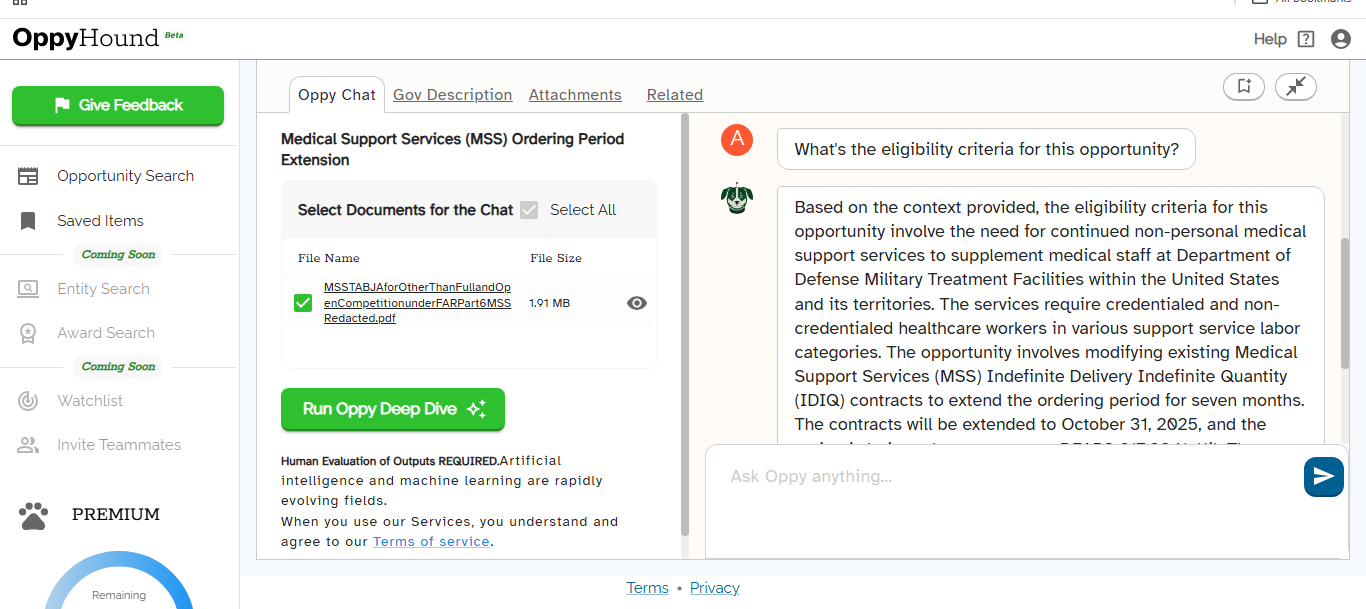
Note: The OppyHound interface is continuously evolving. The screenshots included in this blog may not reflect the most recent updates.

Key Features:

  • Document-Level Keyword Search
    Search directly within solicitation documents to find relevant key words, bidding requirements, deadlines, and terms without scrolling through hundreds of pages.
  • AI-Powered Solicitation Chat and Extraction
    Ask built-in assistant questions like “What are the submission deadlines?” or “Is this a small business set-aside?” and get instant, reliable answers in a PDF report. Extract eligibility, past performance requirements, and submission instructions in seconds.
  • Instant Insight Reports
    Quickly evaluate whether an opportunity is worth your time. OppyHound summarizes the key requirements and highlights areas you need to pay attention to.
  • Real-Time Updates and Watchlists
    Track opportunities, get notified when there are changes, and never miss an amendment or clarification again.
  • SAM.gov Integration for Smart Research
    OppyHound connects directly with SAM.gov updated several time a day, bringing the latest opportunities into one clean interface where you can sort, filter, and prioritize effectively.

Instead of spending hours lost in complex portals and scattered data, OppyHound puts everything in one place. Don’t let the complexity slow you down.  Sign up for free (no credit card required) and see how OppyHound can simplify your path to government contracts.

SIGN UP FREE

Conclusion

Winning government contracts starts with knowing where to look and acting fast when the right opportunity appears. By staying proactive, leveraging the right tools and insights, and focusing on compliance from the start, you can increase your chances of winning contracts that fuel sustainable growth. If you’re a small business aiming for set-aside opportunities or an established company pursuing large-scale government projects, preparation and visibility are the keys to success.

Are you ready to discover contracting opportunities for your business? Sign up for free today on Oppyhound to search and analyze the right contracts.

If you’re ready for the next stage, dive into our full resource: Government Contracting for Startups: A Step-by-Step Guide.

Top 100 Government Contracting Acronyms and Terms: Complete Guide

Build your federal contracting vocabulary with the most important terms every government contractor needs to know.

Success in government contracting requires fluency in specialized terminology. This comprehensive A-Z guide defines 100 essential government contracting terms and acronyms that you encounter throughout the federal procurement process. Master these definitions to communicate effectively and compete successfully for government contracts.

Acronyms 

A | B | C | D | E | F | G | H | I | J | K | L | M | N | O | P | Q

A

  1. ACH – Automated Clearing House
    Electronic payment system used by the government for contractor payments and financial transfers.
  2. ACO – Administrative Contracting Officer
    Government official responsible for contract administration activities after contract award.
  3. ADP – Automatic Data Processing
    Computer-based systems and equipment used for data processing in government operations.
  4. AOR – Authorized Organization Representative
    Individual authorized to submit applications and reports on behalf of an organization in government systems.
  5. API – Application Programming Interface
    Technical specifications that allow different software applications to communicate with government systems.
  6. ATO – Authority to Operate
    Official authorization for information systems to operate in government environments.

B

  1. BAFO – Best and Final Offer
    Contractor’s final proposal submission following negotiation discussions with the government.
  2. BLS – Bureau of Labor Statistics
    Federal agency providing economic data used in government contracting wage determinations.
  3. BOA – Basic Ordering Agreement
    Written understanding between agencies and contractors for future contract terms, but not itself a contract.
  4. BOP – Basic Option Period
    Initial contract option period that may be exercised at the government’s discretion.
  5. BPA – Blanket Purchase Agreement
    Simplified contracting method for repetitive purchases, like “charge accounts” with approved vendors.
  6. BWS – Business and Workforce Solutions
    GSA program providing consulting and professional services to federal agencies.

C

  1. CAC – Common Access Card
    Standard identification card for active duty military personnel and government contractors requiring system access.
  2. CAF – Contract Access Fee
    Fee paid by GSA Schedule contractors, typically 0.75% of sales under the contract.
  3. CAGE – Commercial And Government Entity
    Five-character identifier assigned to businesses doing work with the federal government.
  4. CAP – Contract Administration Plan
    Document outlining how contract performance will be monitored and managed.
  5. CAS – Cost Accounting Standards
    Standards ensuring uniformity in cost accounting for government contracts over certain thresholds.
  6. CAV – Contractor Assistance Visits
    Site visits by government personnel to assist contractors with compliance and performance.
  7. CCR – Central Contractor Registration
    Former system for vendor registration, now integrated into SAM.gov.
  8. CFDA – Catalog of Federal Domestic Assistance
    Database of federal programs providing funding to organizations and individuals.
  9. CFR – Code of Federal Regulations
    Compilation of federal administrative law, including contracting regulations.
  10. CLIN – Contract Line Item Number
    Specific contract line with distinct pricing, delivery, and performance requirements.
  11. CO – Contracting Officer
    Government official with authority to enter into, administer, and terminate contracts.
  12. CONUS – Contiguous United States
    48 adjoining U.S. states plus the District of Columbia, excluding Alaska and Hawaii.
  13. COP – Contract Ordering Period
    Time frame during which orders can be placed under indefinite delivery contracts.
  14. COR – Contracting Officer Representative
    Government employee designated to assist with contract administration and technical oversight.
  15. COTS – Commercial Off-The-Shelf
    Products available in the commercial marketplace without modification.
  16. COTR – Contracting Officer Technical Representative
    Government technical expert responsible for monitoring contractor performance.
  17. CPAF – Cost Plus Award Fee
    Contract type combining cost reimbursement with performance-based award fees.
  18. CPARS – Contractor Performance Assessment Reporting System
    System for documenting contractor performance evaluations.
  19. CPFF – Cost Plus Fixed Fee
    Contract type providing cost reimbursement plus a negotiated fixed fee.
  20. CPIF – Cost Plus Incentive Fee
    Contract type with cost reimbursement and performance-based incentive fees.
  21. CVE – Center for Verification and Evaluation
    VA office responsible for verifying veteran-owned and service-disabled veteran-owned businesses.

D

  1. DAR – Defense Acquisition Regulations
    Former DoD contracting regulations, now incorporated into DFARS.
  2. DB – Davis-Bacon Act
    Federal law requiring prevailing wages on government construction contracts over $2,000.
  3. DCAA – Defense Contract Audit Agency
    DoD agency responsible for contract audits and financial advisory services.
  4. DCMA – Defense Contract Management Agency
    DoD agency providing contract management services across the defense acquisition lifecycle.
  5. DFARS – Defense Federal Acquisition Regulation Supplement
    DoD supplement to the FAR containing defense-specific contracting requirements.
  6. DHHS – Department of Health and Human Services
    Federal department often abbreviated as HHS in contracting contexts.
  7. DISA – Defense Information Systems Agency
    DoD agency providing IT and communications support to warfighters worldwide.
  8. DoD – Department of Defense
    Executive department responsible for national defense and the largest federal contracting agency.
  9. DOL – Department of Labor
    Federal department responsible for occupational safety, wage standards, and employment statistics.
  10. DPA – Delegation of Procurement Authority
    Authorization given to contracting personnel to make procurement decisions.
  11. DUNS – Data Universal Numbering System
    Nine-digit identifier for businesses, being phased out in favor of UEI.
  12. DVBE – Disabled Veteran Business Enterprise
    State-level certification for businesses owned by disabled veterans.

E

  1. EA – Executive Agent
    DoD organization assigned responsibility for common supplies or services.
  2. ECI – Employment Cost Index
    Bureau of Labor Statistics measure used for contract price adjustments.
  3. EDWOSB – Economically Disadvantaged Women-Owned Small Business
    WOSB certification category for businesses meeting economic disadvantage criteria.
  4. EFT – Electronic Funds Transfer
    Electronic payment method used for government contractor payments.
  5. EPA – Environmental Protection Agency
    Federal agency regulating environmental compliance in government contracting.
  6. EPEAT – Electronic Products Environmental Assessment Tool
    System for evaluating environmental attributes of electronic products.

F

  1. FAR – Federal Acquisition Regulation
    Primary regulation governing federal procurement processes and procedures.
  2. FAS – Federal Acquisition Service
    GSA service providing products and services to federal agencies.
  3. FBO – Federal Business Opportunities
    Former procurement opportunity website, now part of SAM.gov.
  4. FFP – Firm Fixed Price
    Contract type with a fixed price that doesn’t change regardless of contractor costs.
  5. FIPS – Federal Information Processing Standards
    Standards for information processing in federal systems.
  6. FISMA – Federal Information Security Management Act
    Law establishing cybersecurity requirements for federal systems and contractors.
  7. FP – Fixed Price
    Contract pricing arrangement where price is predetermined and fixed.
  8. FPDS – Federal Procurement Data System
    Government database containing information on federal contract actions.
  9. FSC – Federal Supply Classification
    System for categorizing supplies and services purchased by the government.
  10. FSS – Federal Supply Schedule
    GSA program providing pre-negotiated contracts for commercial products and services.

G

  1. GAO – Government Accountability Office
    Congressional agency that audits government programs and handles bid protests.
  2. GFE – Government Furnished Equipment
    Equipment provided by the government for contractor use in performance.
  3. GFI – Government Furnished Information
    Information provided by the government to support contract performance.
  4. GSA – General Services Administration
    Federal agency providing centralized procurement and property management services.
  5. GWAC – Government-wide Acquisition Contract
    Contract established by one agency for use across the entire federal government.

H

  1. HCA – Head of Contracting Activity
    Senior contracting official responsible for managing contracting operations.
  2. HHS – Health and Human Services
    Federal department responsible for health and social services programs.
  3. HSPD – Homeland Security Presidential Directive
    Presidential directives related to homeland security requirements.
  4. HUBZone – Historically Underutilized Business Zone
    SBA program for small businesses located in economically distressed areas.

I

  1. IA – Information Assurance
    Measures protecting and defending information and information systems.
  2. IDIQ – Indefinite Delivery, Indefinite Quantity
    Contract type providing for indefinite quantities over fixed periods.
  3. IFB – Invitation for Bid
    Solicitation method used for sealed bidding procurements.
  4. IG – Inspector General
    Independent office responsible for audits and investigations within agencies.
  5. IOA – Industrial Operations Analyst
    Professional responsible for analyzing industrial operations and processes.
  6. IT – Information Technology
    Technology involving computers, software, networks, and electronic systems.
  7. ITAR – International Traffic in Arms Regulations
    Export control regulations for defense articles and services.

J-K

  1. JV – Joint Venture
    Business arrangement where parties retain separate identities while working together.
  2. KO – Contracting Officer
    Alternative abbreviation for Contracting Officer (CO).

L

  1. LH – Labor Hour
    Contract type similar to Time and Materials but without materials component.
  2. LPTA – Lowest Price Technically Acceptable
    Source selection method awarding to lowest-priced technically acceptable offer.

M

  1. MA – Multiple Award
    Contracting strategy awarding contracts to multiple vendors for similar requirements.
  2. MAP – Marketing Action Plan
    Plan developed by contractors to promote their GSA Schedule contracts.
  3. MAS – Multiple Award Schedule
    GSA contracting vehicle providing multiple vendors for similar products/services.
  4. MCS – Minimum Contract Sales
    Minimum sales amount required under certain GSA Schedule contracts.
  5. MPIN – Marketing Partner Identification Number
    Identifier used in GSA’s eBuy system for partner identification.

N

  1. NAICS – North American Industry Classification System
    System for classifying business establishments by economic activity.
  2. NASA – National Aeronautics and Space Administration
    Federal agency responsible for civilian space program and aeronautics research.
  3. NDAA – National Defense Authorization Act
    Annual legislation specifying defense programs and policies.
  4. NDA – Non-Disclosure Agreement
    Legal contract protecting confidential information sharing.

O

  1. OCO – Ordering Contracting Officer
    Official authorized to place orders under indefinite delivery contracts.
  2. OMB – Office of Management and Budget
    Executive office providing budget and management guidance to federal agencies.
  3. OSDBU – Office of Small and Disadvantaged Business Utilization
    Office at each agency advocating for small business contracting opportunities.

P-Q

  1. PCO – Procuring Contracting Officer
    Official responsible for contract formation and pre-award activities.
  2. PGC – Pricing Guideline Coefficients
    Factors used in price analysis and contract pricing decisions.
  3. PII – Personally Identifiable Information
    Information that can identify specific individuals, requiring protection.
  4. PKI – Public Key Infrastructure
    Framework for managing digital certificates and public-key encryption.
  5. PoP – Period of Performance
    Time frame during which contract work must be completed.
  6. PPIRS – Past Performance Information Retrieval System
    System for retrieving contractor past performance information.
  7. PWS – Performance Work Statement
    Document describing performance requirements in performance-based contracts.

Contracting Terms 

A | B | C | D | E | F | G | H | I | J | L | M | N | O | P | Q | R | S | T

A

  1. Acquisition
    The process of obtaining supplies, services, or construction using appropriated funds through purchase, lease, or other contractual arrangements.
  2. Administrative Contracting Officer
    Government official responsible for contract administration functions after award, including monitoring performance and processing modifications.
  3. Affiliate
    Business entity that controls, is controlled by, or is under common control with another business, affecting small business size determinations.
  4. Allowable Cost
    Cost that is reasonable, allocable, and complies with contract terms and applicable cost principles.
  5. Appeal
    Formal request for review of a contracting officer’s decision, typically filed with an agency board or court.
  6. Audit
    Systematic examination of records, documents, and activities to verify compliance with contract requirements.
  7. Award
    Government’s acceptance of a contractor’s offer, creating a binding contractual relationship.

B

  1. Best and Final Offer
    Contractor’s revised proposal submitted after discussions, representing their final terms for contract award.
  2. Best Value
    Source selection approach considering factors beyond price, including technical merit and past performance.
  3. Bid
    Offer submitted in response to an Invitation for Bid, typically in sealed bidding procedures.
  4. Bid Protest
    Formal objection to solicitation terms or award decision, filed with the agency, GAO, or Court of Federal Claims.
  5. Bidder
    Individual or organization submitting a bid in response to a government solicitation.
  6. Blanket Purchase Agreement
    Simplified acquisition method establishing “charge accounts” with contractors for repetitive purchases.
  7. Brand Name or Equal
    Specification method allowing specific brand names while permitting equivalent alternatives.

C

  1. Capability
    Contractor’s ability to satisfactorily perform required work based on past performance, resources, and expertise.
  2. Capability Statement
    Marketing document summarizing company qualifications, certifications, experience, and contact information.
  3. Ceiling Price
    Maximum price payable under cost-reimbursement or incentive contracts, providing cost control.
  4. Certificate of Competency
    SBA certification that a small business has the capability to perform a specific contract.
  5. Closeout
    Administrative process completing all contract requirements and settling final payment issues.
  6. Commercial Item
    Product or service of a type customarily used by the general public or non-governmental entities.
  7. Competitive Proposal
    Procurement method using requests for proposals when conditions aren’t appropriate for sealed bidding.
  8. Consideration
    Something of value exchanged between parties, required for valid contract formation.
  9. Contract
    Mutually binding legal agreement between the government and contractor for supplies, services, or construction.
  10. Contract Administration
    Post-award activities ensuring contractor compliance with contract terms and government requirements.
  11. Contract Modification
    Written change to contract terms, signed by the contracting officer and contractor when required.
  12. Contracting Officer
    Government official with authority to enter into, administer, modify, or terminate contracts.
  13. Contractor
    Individual or organization entering into a contract with the government to provide goods or services.

D

  1. Debarment
    Exclusion of contractors from government contracting for specific periods due to misconduct or poor performance.
  2. Default
    Contractor’s failure to perform contract requirements, potentially leading to termination or other remedies.
  3. Defective Pricing
    Submission of inaccurate, incomplete, or noncurrent cost or pricing data affecting contract prices.
  4. Deliverable
    Specific item, report, or result that must be provided under contract terms.
  5. Delivery Order
    Order for supplies placed against an established contract or agreement.
  6. Discussions
    Negotiations between government and offerors to clarify proposals and improve understanding.

E

  1. Electronic Data Interchange
    Computer-to-computer exchange of structured business documents using standardized formats.
  2. Equitable Adjustment
    Modification to contract price, delivery schedule, or other terms due to changed conditions.
  3. Evaluation Criteria
    Standards used to assess and compare proposals or bids for source selection.
  4. Evaluation Factor
    Element considered in proposal evaluation, such as technical approach or past performance.
  5. Excusable Delay
    Delay in contract performance caused by unforeseeable circumstances beyond contractor control.

F

  1. Fair and Reasonable Price
    Price that represents good value considering quality, delivery, and other relevant factors.
  2. Federal Acquisition Regulation
    Primary regulation governing federal procurement processes and procedures across all agencies.
  3. Final Payment
    Last payment made after contract completion and resolution of all outstanding issues.
  4. Firm-Fixed-Price Contract
    Contract type providing maximum cost certainty with predetermined price regardless of actual costs.
  5. Full and Open Competition
    Procurement process permitting all responsible sources to compete for contract awards.

G

  1. Government Furnished Equipment
    Equipment provided by the government for contractor use in performing contract requirements.
  2. Government Furnished Property
    Any property provided by the government to contractors, including equipment, materials, or facilities.
  3. Grant
    Financial assistance instrument providing money to accomplish public purposes without acquiring goods or services.

H

  1. HUBZone Certification
    SBA certification for small businesses located in historically underutilized business zones.
  2. HUBZone Contract
    Contract awarded under the HUBZone program to qualified small businesses in designated areas.

I

  1. Incentive Contract
    Contract type providing performance incentives through variable fees or prices based on achievement.
  2. Indefinite Delivery Contract
    Contract providing for delivery of indefinite quantities during a fixed period.
  3. Independent Government Estimate
    Government’s estimate of costs for comparison with contractor proposals during evaluation.
  4. Inspection
    Government examination of contractor work to determine compliance with contract requirements.
  5. Invitation for Bid
    Solicitation document used in sealed bidding, requesting bids for specific requirements.

J

  1. Joint Venture
    Business arrangement between two or more parties to pursue specific projects or contracts.

L

  1. Late Bid
    Bid received after the specified submission deadline, generally not considered for award.
  2. Letter Contract
    Written preliminary contractual instrument authorizing contractor to begin work immediately.
  3. Liquidated Damages
    Predetermined monetary compensation for specific breaches, typically late delivery.
  4. Lowest Price Technically Acceptable
    Source selection method awarding contracts to the lowest-priced technically acceptable offeror.

M

  1. Major System
    Combination of equipment, skills, and techniques forming a complete operational unit.
  2. Market Research
    Process of collecting information about capabilities available in the marketplace.
  3. Mentor-Protégé Program
    SBA program pairing large businesses with small businesses to enhance capabilities.
  4. Milestone
    Significant event or achievement point in contract performance used for progress measurement.
  5. Minor Breach
    Contract violation that doesn’t go to the essence of the contract or justify termination.
  6. Multiple Award
    Award of contracts to more than one contractor for similar supplies or services.

N

  1. Negotiation
    Process of bargaining to reach mutually acceptable contract terms between parties.
  2. Noncompetitive Proposal
    Procurement method where proposals are solicited from only one source.
  3. Notice to Proceed
    Written communication directing contractor to begin contract work or specific phases.

O

  1. Offer
    Response to solicitation that, if accepted, would bind the offeror to perform contract requirements.
  2. Offeror
    Individual or organization submitting an offer in response to a government solicitation.
  3. Option
    Unilateral right to purchase additional supplies, services, or extend contract performance periods.
  4. Order of Precedence
    Contractual clause establishing priority when contract documents contain conflicting requirements.

P

  1. Past Performance
    Contractor’s record of performance on previous contracts, used in source selection evaluations.
  2. Performance-Based Contract
    Contract focusing on desired outcomes rather than specific methods of performance.
  3. Performance Bond
    Surety bond guaranteeing contractor performance according to contract terms.
  4. Performance Work Statement
    Document describing performance objectives and standards rather than specific methods.
  5. Period of Performance
    Time during which contract work is authorized and must be completed.
  6. Pre-Award Survey
    Government evaluation of prospective contractor’s capability to perform proposed contract.
  7. Price Analysis
    Process of examining prices without evaluating separate cost elements and profit.
  8. Prime Contract
    Contract awarded directly by the government to a contractor.
  9. Progress Payment
    Interim payment made during contract performance based on work completed.
  10. Proposal
    Offer submitted in response to a request for proposals, including technical and price elements.

Q

  1. Quality Assurance
    Systematic actions ensuring contract performance meets specified requirements and standards.

R

  1. Request for Information
    Government request for information about industry capabilities or potential solutions.
  2. Request for Proposal
    Solicitation method seeking proposals for complex requirements involving negotiations.
  3. Request for Quotation
    Solicitation seeking price quotes for specified requirements, typically simplified acquisitions.
  4. Responsible Bidder
    Bidder possessing capability, integrity, and reliability necessary for contract performance.
  5. Responsive Bid
    Bid conforming to solicitation requirements without material deviation or reservation.

S

  1. Sealed Bidding
    Method of contracting involving public opening of bids and award to lowest responsible bidder.
  2. Service Contract
    Contract for services rather than supplies, subject to specific labor standards.
  3. Set-Aside
    Procurement reserved exclusively for small businesses or other designated business categories.
  4. Small Business
    Business meeting SBA size standards for its primary industry classification.
  5. Sole Source
    Procurement from only one contractor due to unique capability or emergency circumstances.
  6. Statement of Work
    Narrative description of work required, including specifications and performance requirements.
  7. Subcontract
    Contract between prime contractor and another party for portions of prime contract work.
  8. Subcontractor
    Individual or organization having a direct contract with the prime contractor.
  9. Suspension
    Temporary exclusion of contractors from government contracting pending investigation or legal proceedings.

T

  1. Task Order
    Order for services placed against an established contract or agreement.
  2. Technical Evaluation
    Assessment of proposals’ technical merit and feasibility during source selection.
  3. Termination for Convenience
    Government’s right to terminate contracts when it is in its best interest, not due to contractor fault.
  4. Termination for Default
    Contract termination due to the contractor’s failure to perform according to contract terms.

How to Use This Guide:

  1. Study Systematically: Review terms relevant to your current contracting activities
  2. Reference Regularly: Keep this guide handy during proposal development and contract performance
  3. Stay Current: Government contracting terminology evolves, so review updates periodically
  4. Apply Practically: Use proper terminology in communications with government personnel

Ready to put your government contracting knowledge into action? OpportunityHound connects small businesses with federal contracting opportunities. Sign up today to find the relevant opportunities to bid on. 

Request a Demo

Getting Started in Government Contracting: A Beginner’s Guide for Startups

Breaking into government contracting can feel overwhelming for startups. Acronyms, compliance requirements, and an unfamiliar bidding process often make founders hesitate. Yet, the U.S. government is the world’s largest customer, purchasing everything from IT services to food supplies. Understanding the basics of how federal contracts work and who the key players are is the first step to unlocking this massive market.

What are federal contracts?

Federal contracts are legally binding agreements between the U.S. government and private companies to provide goods, services, or solutions in exchange for payment. These contracts range from simple purchases of office supplies to complex multi-billion-dollar defense systems, with bid opportunities spanning every industry and business function.

The government contracts for virtually everything it needs to operate: information technology services, professional consulting, construction, research and development, maintenance services, training programs, food services, and thousands of other categories. This diversity means that almost any legitimate business capability has potential government applications.

Before we dive into the basics, explore our complete guide: Government Contracting for Startups. It walks you through every step of securing your first federal contract.

Overview of the federal procurement process

The Federal Acquisition Regulation (FAR) serves as the primary rulebook governing how federal agencies purchase goods and services. Understanding the FAR framework is essential for successful government contracting, as it establishes the legal and procedural requirements that govern every federal procurement.

The FAR System: The FAR is supplemented by agency-specific regulations (such as the Defense Federal Acquisition Regulation Supplement for DOD contracts) that add additional requirements for particular agencies or contract types. While comprehensive, these regulations are designed to ensure fair competition and protect taxpayer interests.

The contracting cycle for government bids typically follows this pattern:

  1. Requirements Definition: Agencies identify needs and develop statements of work
  2. Market Research: Contracting officers research available solutions and potential vendors
  3. Acquisition Planning: Agencies determine contract type, competition strategy, and evaluation criteria
  4. Solicitation: Most opportunities are published on SAM.gov with detailed requirements
  5. Proposal Submission: Vendors submit proposals by specified deadlines
  6. Evaluation: Government evaluates proposals against published evaluation criteria
  7. Award: Contract is awarded to the selected vendor 
  8. Performance: Contractor delivers goods/services while government monitors performance
  9. Closeout: Contract is completed and administratively closed

Key Players: Who Issues Contracts

The key players in issuing government contracts for bid are a mix of federal agencies, procurement officers, and support organizations. Here’s a breakdown of the most important players startups should know:

1. Federal Government Agencies (Requirements or Funding Agencies)

These are the entities that define requirements and request government contracts for goods or services. Each agency has its own mission, priorities, and budget.

Top Contracting Agencies:

  • Department of Defense (DoD): The largest buyer by far, issuing contracts for everything from cybersecurity to logistics to construction.
  • Department of Veterans Affairs (VA): Buys healthcare services, medical equipment, IT systems, and facility services.
  • Department of Homeland Security (DHS): Buys technology, security services, disaster recovery services, and transportation infrastructure.
  • General Services Administration (GSA): Manages contracts across multiple agencies via long-term GWACs. GSA also manages Multiple Award Schedules (MAS).
  • Health and Human Services (HHS): Procures public health technologies, research services, and data solutions.
  • NASA, Department of Energy (DOE), Department of Transportation (DOT): These agencies also issue a large volume of R&D, infrastructure, and innovation-driven contracts.

2. Procurement Officers and Other Resources

Each role within the federal government’s procurement process serves a unique purpose, and understanding who these individuals are and their value to businesses is crucial. This includes industry resources that help meet federal government small business contracting goals.

  • Small Business Specialist (SBS): Located within federal agencies, the SBS guides small businesses through the procurement process.

They help agencies meet small business goals, provide acquisition insights, and support pre-solicitation planning alongside PCRs and CORs.

  • Contracting Officer (CO/KO): The only person authorized to award and modify federal contracts.

They are warranted to obligate the federal government and manage solicitation releases, make award decisions, and handle legal commitments. Contact them only with specific, contract-related matters.

  • Contract Specialist (CS): Supports the CO during pre-award and post-award phases.

Handles market research, compliance, and communication. May also be assigned duties that align with an SBLO’s responsibilities, or even formally appointed as an SBS, especially in smaller agencies or teams.

  • Contracting Officer Representative (COR): Serves as the day-to-day liaison for contractors after award.

Monitors performance, ensures requirements are met, and communicates updates—but cannot make official changes without CO approval.

  • Acquisition Program Manager (APM or PM): Manages the technical side of a program.

Not directly involved in contracting but offers insight into agency needs and future requirements—valuable for shaping your proposal strategy.

  • Procurement Center Representative (PCR): This person is a Small Business Administration (SBA) official assigned to a federal contracting activity to advocate for small businesses in the federal procurement process.  

Ensures agencies include small businesses in procurement plans. Reviews acquisition strategies, suggests set-asides, and helps small businesses compete more effectively.

Tip: Building relationships with contracting officers can improve your odds of success. Attend industry days and virtual agency events to connect.

3. Small Business Offices (OSDBUs)

Offices of Small and Disadvantaged Business Utilization help small businesses help navigate government contracts for socioeconomically owned small businesses, such as small disadvantaged or woman owned small businesses, and other small business categories. Each major agency has its own OSDBU that:

  • Educate and advocate for small businesses
  • Facilitate matchmaking with buyers
  • Guide on set-aside programs and certifications
  • Government assistance for small businesses

4. Prime Contractors

A prime contractor is a company or organization that has a direct contractual agreement with a government agency to perform work or provide goods and services. For the most part, large business prime contractors must subcontract portions of the work to smaller businesses through government subcontracting opportunities.

Startups can partner with or subcontract to primes as a path to gaining federal past performance and entering into new government markets such as DHS or VA.

5. SBA and APEX Accelerators

Small Business Administration (SBA) helps define eligibility and provides key certifications fro socioeconomic small businesses (i.e., 8(a), SDVOSB, VOSB, WOSB, HUBZone).

APEX Accelerators (formerly PTACs) provide free support to help small businesses navigate contracting, including proposal reviews and bid strategy. There are around 90 APEX Accelerators in the U.S., with about 300 local offices throughout the 50 states, Washington D.C., Puerto Rico, Guam, the U.S. Vergin Islands, and the Commonwealth of Northern Marianas. 

6. General Services Administration (GSA)

The GSA runs the MAS program, a major contracting vehicle for selling commercial products and services across federal agencies. GSA also manages several GWACs, identified later in this guide. If you’re eligible, having a GSA schedule or GWAC simplifies how agencies buy from you.

7. Congress and OMB (Indirect Influence)

While not directly issuing contracts, Congress controls the federal budget, and the Office of Management and Budget (OMB) sets government-wide acquisition policy. Their priorities shape agency procurement behavior and spending focus areas.Understanding who makes purchasing decisions and when they make them is crucial for targeting your marketing efforts effectively.

Budget Cycles: The federal fiscal year runs from October 1 to September 30.Understanding this cycle is crucial because:

  • Budget planning typically occurs 12-18 months in advance
  • Most procurement activity peaks in the spring and early summer
  • “Use it or lose it” spending creates bid opportunities in July through September
  • New fiscal year (October 1st) brings fresh budgets and renewed procurement activity

Size standards as per SBA

The Small Business Administration (SBA) establishes size standards that determine whether a business qualifies as “small” for federal contracting purposes. These standards vary by industry and are matched to the NAICS (North American Industry Classification System) codes. 

The SBA uses two primary size standards to determine if a business qualifies as small: 

  • Average number of employees, or
  • Average annual receipts (revenue) over the last five years

You can find the official rules in 13 CFR Part 121 of the federal regulations.

Important Definitions to Know

  • Annual Receipts: This includes total income plus cost of goods sold, averaged over the last 5 fiscal years. For newer businesses, average weekly revenue is multiplied by 52.
  • Employee Count: Calculated as the average number of employees per pay period over the last 24 months, regardless of hours worked or employment status. For businesses under 24 months old, use the average for the time in business.
  • Affiliates: When calculating size, you must include the employees or revenue of all affiliated companies. Affiliation is based on control, which may exist even without 50% ownership if one party has significant influence.

Learn the full definitions of these terms, and others, in 48 CFR 19

Key Considerations:

  • Size is determined at the time of proposal submission for each contract
  • Affiliations with other companies may count toward size calculations
  • Size standards can change, so verify current standards before bidding
  • Exceeding size standards doesn’t disqualify you from all government work, just set-aside opportunities

If you’re new to GovCon and want a detailed roadmap, don’t miss our full guide: Government Contracting for Startups: A Step-by-Step Guide.

What government buyers look for when evaluating vendors

Government buyers evaluate vendors differently than commercial customers when reviewing government bids, with unique priorities shaped by accountability requirements and risk aversion:

Past Performance: Government buyers heavily weight past performance, particularly on similar government contracts. This creates a “chicken and egg” problem for new contractors, making it essential to start with smaller opportunities to build a track record.

Technical Capability: Buyers need confidence that you can deliver what you promise. This includes not just your solution approach, but your team’s qualifications, experience, and ability to handle government-specific requirements.

Price Reasonableness: While not always the deciding factor, price must be competitive and reasonable. Government buyers must justify their selections and often face audits, making “best value” approaches that balance price and performance common.

Responsibility and Integrity: Vendors must demonstrate financial stability, business integrity, and the organizational capability to perform. This includes having adequate facilities, equipment, personnel, and financial resources.

Compliance Capability: Government contracts include numerous compliance requirements (reporting, security, labor standards, etc.). Buyers evaluate whether vendors understand and can meet these obligations.

Federal contracting isn’t reserved for big corporations. With the right knowledge, even small businesses and early-stage startups can secure government contracts and build a steady revenue stream. By understanding the procurement process, identifying the decision-makers, and learning where your company fits, you position yourself ahead of competitors who are still avoiding this space. Start small, build your past performance, and use free resources like SBA or APEX Accelerators to guide your first steps. 

Sign up free today to find and bid on contracts that can grow your business.