|
Executive Summary
|
The third week of April 2026 delivers one of the most consequential sets of federal contracting developments of the year. Congress finalized the first major SBIR/STTR reauthorization in over a decade, restoring a $4 billion-per-year innovation pipeline. The U.S. Space Force awarded a $1.84 billion Andromeda IDIQ to 14 firms. The Court of Federal Claims cleared the VA’s $60.7 billion T4NG2 vehicle with a 33-vendor list. NASA is racing to extend SEWP V past its April 30 expiration because SEWP VI proposal evaluations are blocked by nine active GAO protests. OMB memo M-26-10 now requires agency CIOs to personally approve IT contracts and submit machine-readable utilization data. Meanwhile, the FAR semiconductor rule comment deadline is today (April 20), the DOL independent contractor rule comment deadline is April 28, and SBA continues aggressive restructuring of the 8(a) program with termination proceedings against 628 firms.
|
Top Developments
|
Development 01 | Legislative Action
SBIR/STTR Reauthorization Becomes Law After Six-Month Lapse, Restores $4B Innovation Pipeline Through FY2031
|
|
After the SBIR and STTR programs lapsed on September 30, 2025, Congress finalized the most significant reauthorization in over a decade. The Senate passed S. 3971, the Small Business Innovation and Economic Security Act, by voice vote on March 3, 2026. The House approved it 345 to 41 on March 17, 2026. President Trump signed the legislation into law on April 13, 2026. The bill reauthorizes both programs through September 30, 2031, and extends required funding levels through fiscal year 2031, restoring roughly $4 billion in annual small business innovation funding across DoD, HHS/NIH, DOE, NASA, NSF, and other participating agencies. The approximately $6 billion measure also introduces new national security review requirements, a Strategic Breakthrough Allocation Program letting large-SBIR agencies fund up to $30 million awards for 48-month performance periods, and new per-firm proposal submission limits.
The six-month lapse had already disrupted solicitation cycles at multiple agencies. NIH issued NOT-OD-26-006 announcing the early expiration of several SBIR/STTR Notices of Funding Opportunity and providing guidance for existing recipients. With reauthorization now in force, contracting officers can resume Phase I and Phase II awards on a regular cadence, and innovation-focused small businesses should begin tracking the refreshed topic lists each agency is expected to publish over the next 60 to 90 days. The five-year runway gives small businesses predictability that has been missing since the program first lapsed in 2022.
Source: Congress.gov, S. 3971 and H.R. 3169 records (119th Congress); SBA press release, April 13, 2026, “Administrator Loeffler Applauds SBIR-STTR Reauthorization”; International Economic Development Council, April 1, 2026; Crowell & Moring, April 2026.
|
|
Development 02 | Agency Signal
Army Awards Anduril $20B Enterprise Agreement, Copying and Extending the Palantir Model
|
|
On March 14, 2026, the U.S. Army awarded Anduril Industries a 10-year enterprise agreement worth up to $20 billion (five-year base plus five-year option) that consolidates more than 120 separate procurement actions into a single contracting vehicle. The structure mirrors the $10 billion Palantir enterprise service agreement the Army signed in August 2025, which rolled up 75 Palantir-related contracts (15 prime plus 60 related) into one ordering mechanism with pre-negotiated prices. An April 2, 2026 procurement analysis noted that these enterprise vehicles are likely to speed procurement but not without risk, flagging concerns about reduced competition, oversight challenges, and the precedent being set for venture-backed primes.
For the government contracting community, the enterprise agreement pattern is now established at the Army and spreading. It has three immediate implications. First, it consolidates incumbency: once a company is on an enterprise vehicle, the Army has strong incentive to buy through it rather than compete. Second, it elevates the strategic value of teaming and subcontracting on these vehicles, because prime access is increasingly locked. Third, it creates a procurement playbook other services and agencies are likely to copy, particularly for software platforms with broad user bases. Contractors should begin mapping their capabilities against the Anduril and Palantir vehicle scopes to identify where subcontract opportunities exist.
Source: Nextgov/FCW, March 2026; TechCrunch, March 14, 2026; Army.mil, July 31, 2025 Palantir ESA announcement; USSANews, April 2, 2026 enterprise vehicle risk analysis.
|
|
Development 03 | RFP Update
Space Force Awards $1.84B Andromeda Space Domain Awareness IDIQ to 14 Firms, 10-Year Vehicle Open Through 2036
|
|
On April 7, 2026, the U.S. Space Force’s Space Systems Command awarded $1.843 billion in Andromeda program contracts to 14 companies to field next-generation space domain awareness and orbital surveillance capabilities. The awards are structured as firm-fixed-price indefinite-delivery, indefinite-quantity contracts running through April 8, 2036. The competition drew 32 offers and resulted in awards to a mix of traditional primes and non-traditional entrants: Anduril Industries, Lockheed Martin, Boeing’s Millennium Space Systems, Northrop Grumman, L3Harris Technologies, BAE Systems, Sierra Space, Redwire, General Atomics, Astranis Space Technologies, True Anomaly, Turion Space, Intuitive Machines, and Quantum Space. At the time of award, the Space Force obligated $1.4 million in research, development, test, and evaluation funding.
Andromeda is designed to acquire and field the next generation of space-based systems that track, identify, and analyze platforms on orbit, replacing the Geosynchronous Space Situational Awareness Program (GSSAP) capability over time. Task orders will be competed among the 14 awardees. Companies outside the vehicle should immediately begin identifying teaming and subcontracting opportunities with awardees. Space-focused small businesses should particularly target the non-traditional primes, which typically have more flexible supply chains and stronger appetite for smaller partner contributions.
Source: Space Force press release, Space Systems Command, April 2026; DefenseScoop, April 10, 2026; Defense Daily, April 2026; Via Satellite, April 9, 2026.
|
|
Development 04 | RFP Update
Court of Federal Claims Clears VA’s $60.7B T4NG2 IT Vehicle, Finalizing 33-Vendor Award Pool
|
|
On April 3, 2026, Judge Molly R. Silfen of the U.S. Court of Federal Claims ruled that the Department of Veterans Affairs can proceed with T4NG2 (Transformation Twenty-One Total Technology Next Generation 2), the VA’s 10-year, $60.7 billion successor IT services vehicle. The ruling concluded what the court described as a “very large bid protest” and effectively finalized the VA’s list of 33 authorized vendors. T4NG2 is the primary contract the VA will use to acquire cybersecurity, systems engineering, software development, and electronic health record support services over the next decade. Certain protesters, including Taurian Consulting, Technatomy Corp., and Peregrine Digital Services, were added to the award pool during the litigation before the final decision.
With T4NG2 now cleared, the next phase is task order release. The VA is preparing to execute task orders against T4NG2 that cover cybersecurity modernization, EHR integration work with Accenture Federal Services, benefits system updates, and enterprise software support. For the 33 prime awardees, the focus turns to standing up capture teams and lining up subcontractors for the earliest task orders. For non-primes, the opportunity is subcontracting onto prime teams, particularly those with specialized cybersecurity or healthcare IT capabilities that the primes may not carry in-house.
Source: Stars and Stripes, April 3, 2026; Washington Technology, March 2026 T4NG2 protest coverage; U.S. Court of Federal Claims, April 2026 ruling.
|
|
Development 05 | Agency Signal
NASA Races to Extend SEWP V Past April 30 Expiration, SEWP VI Blocked by Nine Active GAO Protests
|
|
NASA is on the verge of executing a modification to extend SEWP V, the $60 billion government-wide IT acquisition contract, past its April 30, 2026 expiration date. The current ordering period ends April 30 and the extension is expected to run through September 30, 2026. The need arose because SEWP VI, the $60 billion successor vehicle, cannot move to award while nine active GAO protests from companies whose proposals were rejected during Phase One of the evaluation process remain pending. GAO deadlines to rule on the protests fall in late May and early June 2026, well past the SEWP V end date.
For federal IT buyers and contractors selling IT hardware, software, and related services, the SEWP V extension is both reassurance and warning. Reassurance, because agencies can continue placing orders through SEWP V without a gap in contract authority. Warning, because the extension confirms SEWP VI is delayed indefinitely, and any capture strategy that depended on a mid-2026 award is now at risk. Contractors holding SEWP V positions should plan for an additional five months of order flow through the vehicle, and should prepare to adjust their SEWP VI positioning strategies as the GAO protest rulings come in.
Source: Nextgov/FCW, March 2026; Washington Technology, March 2026 nine GAO protests; NASA SEWP program office, April 2026 contract notices.
|
|
Development 06 | Acquisition Policy
OMB Memo M-26-10 Requires Agency CIOs to Personally Approve IT Contracts, Submit Machine-Readable Utilization Data
|
|
On March 31, 2026, OMB issued memorandum M-26-10 on transparency, accountability, and oversight of federal technology, reinforcing FITARA (the Federal Information Technology Acquisition Reform Act of 2014) and significantly expanding the data agency CIOs must submit on IT purchases. Starting in May 2026, CIOs will begin submitting to OMB details about all contracts or other agreements for IT or IT services that they personally approve, plus contracts approved by a CIO delegee where those contracts directly enable or facilitate interaction between the public and the federal government through digital services. Agencies must also request information about their own utilization rates and prices paid for IT products and services, and must include provisions on future contracts to require that data to be disclosed to the government, including to other agencies, in a machine-readable format.
The operational impact on contractors is immediate. Federal IT buyers will be required to include new contract clauses mandating utilization and pricing transparency, and contractors will have to adjust their response processes to handle those new disclosures. Federal CIO Greg Barbaccia has publicly stated the goal is to ramp up enforcement of FITARA. The memo effectively ends the automated data collection approach used since the FITARA dashboard launched in 2009, requiring manual CIO-level submissions that could slow some IT contract approvals but increase visibility into shadow IT across agencies.
Source: OMB memorandum M-26-10, March 31, 2026; Federal News Network, April 2026; Nextgov/FCW, March 2026; Executive Gov, April 2026.
|
|
Development 07 | FAR Change
FAR Semiconductor Prohibition Proposed Rule Comment Window Closes April 20: Contractors Face New Disclosure and Sourcing Obligations
|
|
The FAR Council’s proposed rule, “Federal Acquisition Regulation: Prohibition on Certain Semiconductor Products and Services,” published in the Federal Register on February 17, 2026, has a public comment deadline of April 20, 2026, the publication date of this brief. The rule would restrict federal acquisition of electronic products and services that incorporate certain semiconductor products, subsidiaries, or services, implementing statutory restrictions on procurement from designated foreign sources. If finalized in its current form, the rule will add new clauses requiring contractors to represent whether covered semiconductors are used in delivered items, to disclose supply chain information, and to refresh representations during contract performance.
The practical compliance burden will fall heaviest on IT, electronics, and telecommunications contractors whose products incorporate third-party semiconductor components. The rule structure parallels Section 889 (the Huawei/ZTE covered telecommunications prohibition), which required contractors to develop supply chain visibility into hardware embedded deep in their product offerings. Many contractors found Section 889 compliance far more expensive and time-consuming than initial estimates suggested. Today is the last day to submit public comments to shape the final rule. Responsive comments should focus on implementation timelines, subcontractor flow-down, and the scope of covered semiconductor categories.
Source: Federal Register, February 17, 2026; Wilson Sonsini, February 2026; Acquisition.gov, FAR Council open case docket.
|
|
Development 08 | Small Business
SBA Initiates Termination Proceedings Against 628 Firms in 8(a) Program, Signals Materially Narrower Program Going Forward
|
|
On March 4, 2026, the Small Business Administration announced it had initiated termination proceedings against more than 620 firms in the 8(a) Business Development Program for refusing to produce three years of financial documents requested by the agency. That March 4 action followed an earlier move in February 2026, when SBA initiated termination proceedings against 154 Washington, D.C.-based 8(a) firms that failed to meet “economic disadvantage” eligibility requirements. In total, SBA suspended more than 1,000 firms during the winter for failing to respond to a December 2025 data call that required all 4,000-plus 8(a) participants to submit significant amounts of financial and eligibility documentation by January 19, 2026.
The enforcement campaign follows the January 22, 2026 SBA policy guidance that the agency will administer 8(a) on a strictly neutral basis, eliminating race-based presumptions of social disadvantage in response to the 2023 Eastern District of Tennessee ruling. The combined effect is a materially narrower 8(a) program. Only 65 new firms were admitted to the program in calendar year 2025. For currently certified 8(a) firms, the immediate action is document compliance. Any firm that has not responded to the data call should submit immediately or risk termination. Firms pursuing set-aside contracts under 8(a) should factor termination risk into teaming strategies and ensure that prime 8(a) partners are in good standing before committing to joint ventures.
Source: SBA press release, March 4, 2026; Holland & Knight, January 2026; Covington & Burling (Inside Government Contracts), January 2026; SBA announcement, January 22, 2026.
|
|
Development 09 | Agency Signal
SpaceX Wins $178.5M SDA-4 Task Order Under NSSL Phase 3 Lane 1 to Launch Missile Tracking Satellites
|
|
On April 1, 2026, the U.S. Space Force awarded SpaceX a $178.5 million task order under the National Security Space Launch (NSSL) Phase 3 Lane 1 program to launch missile tracking satellites for the Space Development Agency. The contract, designated SDA-4, covers two Falcon 9 launches beginning in Q3 2027, one from Cape Canaveral Space Force Station in Florida, the other from Vandenberg Space Force Base in California. The satellites, built by Sierra Space, support the Space Development Agency’s missile threat detection and tracking mission from orbit. The award falls within the broader NSSL Phase 3 architecture, with Lane 2 firm-fixed-price indefinite-delivery contracts spanning five years (FY25–FY29) worth nearly $14 billion across Blue Origin, SpaceX, and United Launch Alliance.
For launch providers and the broader space sector, the SDA-4 award continues an important pattern: NSSL Phase 3 Lane 1 is active, being used for lower-cost missions and non-traditional pathways to orbit. Contractors supporting missile defense architecture (sensors, data analytics, ground operations, satellite integration) should align capture strategies with the Space Development Agency’s proliferated warfighter space architecture cadence. The Sierra Space satellites are part of a larger SDA constellation that will drive multiple task order releases over the next 18 to 24 months.
Source: Space Force press release, April 1, 2026; Space.com, April 2026; Teslarati, April 2026; SpaceNews archive, April 2025 NSSL Phase 3 framework coverage.
|
|
Development 10 | Legislative Action
DOL Independent Contractor Rule Comment Period Closes April 28: Federal Contractors Face Narrower Core-Factor Test
|
|
The Department of Labor’s proposed rule on independent contractor classification, published in the Federal Register on February 27, 2026, has a public comment deadline of April 28, 2026. The rule would replace the 2024 Biden-era six-factor analysis with a streamlined approach centered on two “core” factors: the nature and degree of the worker’s control over the work, and the worker’s opportunity for profit or loss. The DOL has scheduled a public roundtable for April 9, 2026 through the SBA Office of Advocacy. Comments go to Docket ID WHD-2026-0001 on Regulations.gov. The rule would apply a single, uniform analysis under the Fair Labor Standards Act, the Family and Medical Leave Act, and the Migrant and Seasonal Agricultural Worker Protection Act.
For federal contractors, the rule carries two direct operational implications. First, many federal contractors rely heavily on 1099 subcontractors and independent consultants to staff proposals, technical reviews, and short-duration task order work. A narrower test that focuses on control and profit/loss opportunity will change which workers qualify as independent contractors versus employees. Second, the rule will interact with the Service Contract Act and Davis-Bacon Act wage determinations. Contractors should map their current 1099 workforce against the proposed two-factor test before the comment window closes.
Source: Federal Register, February 27, 2026; Jackson Lewis, March 2026; Mayer Brown, March 2026; SelfEmployed.com, March 2026.
|
Impact Analysis
Enterprise agreements and multi-award IDIQs are now the dominant model for large federal technology buys. The Anduril $20B enterprise agreement, Palantir $10B enterprise service agreement, Andromeda $1.84B IDIQ with 14 vendors, T4NG2 $60.7B with 33 vendors, and SEWP V/VI $60B ceiling collectively signal a structural shift in federal buying. Prime incumbency on these vehicles is now more valuable than ever, and the subcontracting market beneath them is correspondingly more important. Small businesses should prioritize teaming relationships with the primes on these vehicles over chasing standalone opportunities, and should target the non-traditional primes (Anduril, Sierra Space, Redwire, True Anomaly) whose supply chains are typically more accessible to smaller partners than traditional primes.
Small business programs are simultaneously expanding and contracting. Expansion comes from SBIR/STTR reauthorization, which restores a $4 billion annual pipeline across nearly a dozen agencies and gives small innovators five-year predictability through FY2031. Contraction comes from the SBA’s aggressive 8(a) program restructuring: 628 termination proceedings, only 65 new admissions in 2025, and a race-neutral administration standard that fundamentally changes eligibility. Small business contractors that historically relied on 8(a) set-asides should evaluate whether HUBZone, WOSB, SDVOSB, or SBIR/STTR pathways offer better positioning for their capabilities. The July 1, 2026 HUBZone map expirations for redesignated areas add another compliance trigger for firms using that vehicle.
Regulatory compliance burdens on federal contractors are intensifying on multiple fronts simultaneously. The FAR semiconductor rule (comment deadline today, April 20), the DOL independent contractor rule (comment deadline April 28), and OMB M-26-10’s CIO-level data submission requirements each impose new representation, disclosure, or data obligations. For small businesses in particular, the cumulative compliance burden is increasingly expensive relative to contract value, and companies should begin evaluating whether their compliance infrastructure can handle the incremental load without additional investment.
Space Force and space-focused procurement continue to be the most active high-growth sector. Andromeda ($1.84B) and SDA-4 ($178.5M) within two weeks of each other signal sustained procurement velocity, and the SDA’s proliferated architecture cadence means more task order releases are coming through 2027. Contractors outside the space sector may want to evaluate adjacent capability applications in space domain awareness, data analytics, satellite ground systems, and launch support services, because the addressable market is expanding faster than traditional defense segments.
Recommended Actions
|
SBIR/STTR-ELIGIBLE FIRMS
Monitor agency SBIR topic publications over the next 60 to 90 days. DoD, NIH, DOE, NASA, and NSF are likely to publish refreshed topic lists by early summer. Firms with prior Phase I or Phase II awards should verify status and explore Phase III commercialization pathways against the reauthorization’s updated provisions.
|
|
ARMY CAPTURE TEAMS (ANDURIL / PALANTIR)
Map your firm’s capabilities against the published scope of each enterprise vehicle. Identify two to three specific task categories where your firm can team with the prime or subcontract. Initiate outreach to prime business development contacts now, because early task order formation is where teaming partners are selected.
|
|
T4NG2 AWARDEES AND PURSUERS
The 33 prime awardees should stand up capture teams for the earliest task order releases, expected in Q2 2026. Non-primes should pursue teaming relationships now, targeting primes with gaps in specialized cybersecurity, healthcare IT, or EHR integration capabilities.
|
|
SEWP V INCUMBENTS
Plan for an additional five months of ordering activity through September 30, 2026. Monitor the formal extension execution, which NASA indicated is imminent. Begin preparing contingency plans if the SEWP VI GAO protest rulings in May and June 2026 result in further delays.
|
|
FAR SEMICONDUCTOR RULE COMMENTERS
Submit substantive comments on the FAR semiconductor rule today (April 20 deadline). Focus comments on implementation timelines, subcontractor flow-down, and scope definitions. Begin internal supply chain mapping of semiconductor components in delivered products regardless of final rule timing.
|
|
8(a) PROGRAM PARTICIPANTS
Verify your firm’s document submission status with the SBA. If the December 2025 data call request has not been fulfilled, submit immediately. Review eligibility under the January 22, 2026 race-neutral guidance and prepare updated social disadvantage documentation. Ensure any 8(a) prime partners in joint ventures are in good standing with SBA.
|
|
CONTRACTORS USING 1099 SUBCONTRACTORS
Map your current 1099 workforce against the proposed two-factor test (control and profit/loss opportunity) before the April 28 comment deadline. Submit comments that reflect federal contract execution realities. Evaluate whether any categories of workers might need to be reclassified as W-2 employees.
|
OpportunityHound Spotlight
|
Contractors navigating this week’s developments face a common challenge: the volume and velocity of federal procurement activity keeps accelerating while the analytical work to prioritize opportunities stays difficult. Five different buying vehicles ($20B Anduril, $10B Palantir, $1.84B Andromeda, $60.7B T4NG2, $60B SEWP V/VI), two federal rule comment deadlines (semiconductor April 20, independent contractor April 28), and a restructured 8(a) program with termination risk each require separate tracking, assessment, and response.
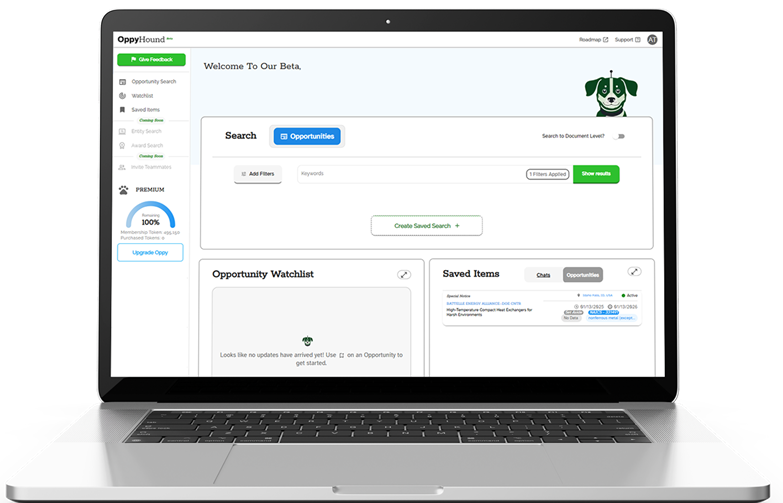
OpportunityHound’s Contract Opportunities search and filter helps BD and capture teams work this volume efficiently. The platform pulls directly from SAM.gov, lets you filter by NAICS, agency, set-aside type, and dollar threshold, and lets you save searches that alert you when new matching opportunities post. For firms targeting task order flow under T4NG2, Andromeda, or the enterprise agreements, the Contract Awards analysis feature shows historical award patterns, incumbent identification, and spending trends across agencies, supporting the competitive positioning work that comes after an RFP drops.
Companies building an 8(a), SBIR, or small business set-aside pipeline benefit from AI-Powered Filters that narrow results by page count, key personnel requirements, and clearance level, helping smaller firms find opportunities they can actually pursue without overcommitting resources.
Sign up free at oppyhound.com or book a demo to see how it works.
|
Forecast & Emerging Signals
| ● |
Late April 2026. FAR semiconductor rule comment period closes April 20 (today). DOL independent contractor rule comment period closes April 28. OMB M-26-10 CIO data submissions begin in May 2026.
|
| ● |
May–June 2026. GAO rules on nine active SEWP VI protests. The rulings will determine whether NASA can proceed with SEWP VI award, or whether further protest rounds delay the vehicle further. SEWP V extension execution expected imminently.
|
| ● |
Q2 2026. T4NG2 task order releases begin after court clearance on April 3. First wave likely focuses on cybersecurity and EHR integration work.
|
| ● |
Mid-2026. Agency SBIR/STTR topic lists expected to refresh under the new reauthorization. Watch for DoD, NIH, NASA, NSF, and DOE first-quarter topic publications.
|
| ● |
July 1, 2026. HUBZone redesignated areas from the 2023 map update expire. Firms with principal offices in those areas must prepare for eligibility transitions.
|
| ● |
Late Summer 2026. FAR semiconductor final rule publication expected if FAR Council maintains typical timeline after close of comment period.
|
Key Resources & References
Authoritative public sources supporting this week’s developments. Use for direct tracking of rulemaking dockets, contract vehicle information, and agency policy guidance.
| NIH NOT-OD-26-006
Notice of Early Expiration of NIH SBIR/STTR Notices of Funding Opportunity.
|
Additional Recommended Reading
|