In federal contracting, IDIQ stands for Indefinite Delivery, Indefinite Quantity. This type of contract is a flexible ordering vehicle. It lets an agency order an unknown number of products or services over a set period (often 5 years). In plain terms, the government agrees to a minimum quantity and a maximum ceiling, but the exact amount isn’t fixed at award. This setup is ideal when the agency expects recurring needs but can’t predict quantities in advance.
If you’re a new contractor or looking to expand into more predictable revenue streams, understanding how IDIQs work is essential. In this article, we’ll dive deep into details.
What Is an IDIQ Contract?
An IDIQ contract is a type of indefinite delivery contract. Unlike a fixed-quantity contract, it does not specify exact quantities of work or supplies upfront. Instead, the contract sets:
- Minimum and Maximum Quantities: The agency negotiates a minimum guarantee (what it must order at least) and a ceiling (the max it may order). Think of it as a contract range – e.g. “between $100K and $10M worth of work.” The minimum is usually modest and reflects what the government is fairly certain it will use.
- Delivery Period: A fixed time frame (typically a one-year base with four, one-year options). Many larger IDIQ contracts are ten-year contracts (typically a five-year base with five, one-year options). Orders are placed as needed during this period.
- Ordering Process: When the agency needs work done, it issues a task order (for services) or delivery order (for supplies) under the IDIQ. The contract defines how orders are requested and filled but doesn’t lock in a quantity at the start.
IDIQ contracts streamline procurement because the government doesn’t have to run a full competition for every small purchase. Once the IDIQ is in place, the agency can quickly place orders against it rather than drafting and awarding a new contract each time. This saves time and cost for both the agency and contractors. Please note, contractors cannot bid on task or delivery orders unless they win an award on the IDIQ contract; therefore, winning a spot on an IDIQ can mean a steady pipeline of task orders / delivery orders.
Single-Award vs. Multiple-Award IDIQ
IDIQ contracts are of two types, based on how many vendors are awarded:
- Single-Award IDIQ: The agency awards the contract to one contractor. It’s straightforward, all orders go to that vendor. This can simplify pricing and management, but it means the government relies on a single source, which adds risk if that vendor underperforms. For you as a contractor, being the lone IDIQ holder means you’ll get every task order (following the contract terms).
- Multiple-Award IDIQ (MA IDIQ): The agency awards multiple vendors under the same solicitation. All awardees agree to the same basic terms and pricing structure. When an order comes in, the agency competes it among the IDIQ holders: it will typically issue a mini-RFP (or a Task Order Request for Proposal – TORFP) so the qualified vendors can bid on that specific task. The FAR even requires agencies to give all IDIQ holders “fair opportunity” to compete for each order. MA IDIQs have become the norm in recent years because they balance flexibility and competition.
How IDIQ Orders Work
Once an IDIQ contract is awarded, work happens via orders:
- Task Orders vs. Delivery Orders: If the IDIQ is for services (e.g. consulting, IT, maintenance), the agency places task orders. If it’s for goods (e.g. equipment, supplies), it uses delivery orders. Each order will spell out the scope, schedule, and funds for that specific work.
- Pricing Methods: An IDIQ contract may use various pricing types. It could be firm-fixed-price (common for supplies or clear-cut tasks), time-and-materials (for hourly-based services), or cost-reimbursement (for research or uncertain work). The contract defines pricing ceilings or rates, but final price is determined when each order is set.
- Competition: Under a single-award IDIQ, the ordering process is simple. The agency gives the task order to the sole contractor (according to the contract’s terms). Under a multiple-award IDIQ, each task order is competing among the contract holders. In practice, the agency issues a short notice and a small bid window, then selects the best offer from the pool.
Benefits of IDIQ: For agencies, IDIQs “streamline the contract process and speed service delivery”. They don’t have to repeat lengthy procurements for every need.
For contractors, IDIQs offer potential long-term work: once you’re on an IDIQ, you’re running all related orders. It’s especially useful for small or new vendors – winning an IDIQ (often set aside for small business categories) provides a foot in the door and recurring business.
Examples of IDIQ Contracts
IDIQs are everywhere in federal procurement. A few examples:
- IT and Consulting Services: Large IDIQs like the GSA Alliant GWAC (Governmentwide Acquisition Contract) for IT systems or various agency IT support IDIQs let tech contractors bid on projects without knowing exact future needs. For instance, an Air Force engineering firm on an IT support IDIQ might receive task orders each quarter for specific software updates or helpdesk staff.
- Construction and Maintenance: The Army Corps of Engineers often uses IDIQs for construction projects. One example: a single-award IDIQ with a construction firm to handle road repairs and bridge maintenance over several years. The Corps issues individual work orders when infrastructure needs to be fixed.
- Office Supplies and Equipment: Some indefinite delivery schedule contracts (like the GSA Multiple Award Schedule) work like IDIQs: agencies order stationery, hardware, and furniture as needed up to contract limits. Smaller firms might compete for sub-tasks under larger IDIQ vehicles.
How to Find and Win IDIQ Contracts
Finding IDIQ opportunities requires targeted search and tracking. Key tips for contractors:
- Search SAM.gov and Agency Sites: Use keywords like “IDIQ” and relevant NAICS codes. SAM.gov lets you filter by contract type and agency. Look for solicitations labeled as IDIQ, GWAC, BPAs (Blanket Purchas Agreement), or schedules. Also check agency procurement forecasts and FedBizOpps notices for coming IDIQ recompetes or set-aside solicitations.
- Leverage Industry Events: Agencies sometimes announce or preview big IDIQ buys at industry days or conferences. Attending these can give early insight.
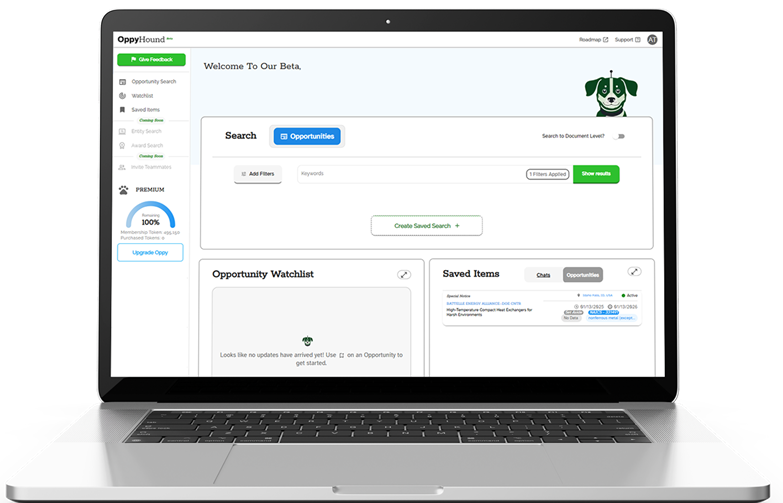
- Use Advanced Tools like OppyHound: Rather than manually sifting through hundreds of posts, try an AI-powered search platform. OppyHound lets you search within attached docs and filter results by criteria like NAICS and agency
For example, OppyHound’s interface can highlight active IDIQ solicitations and even past task orders. By filtering your specialty (e.g. cybersecurity or medical), you can see which agencies have IDIQs coming up and who already holds them. This saves hours of manual searching. You can also get alerts on changes to IDIQ solicitations you’re watching.
- Prepare Your Team: Make sure your registrations (SAM, SBA profiles, etc.) are up to date. Gather references and CVs ahead of time. IDIQ proposals often ask for broad qualifications since orders will be defined later.
By proactively searching and using the right tools, you can spot IDIQ opportunities that fit your capabilities. OppyHound’s search can be especially handy, you’ll spend less time clicking through SAM.gov and more time focusing on winners.
Conclusion
IDIQ contracts are a cornerstone of government procurement when needs are ongoing but uncertain. They offer flexibility to the agency and a chance for contractors to win steady work. As a government contractor, understanding IDIQs can open doors to new projects, from IT services and construction to medical staffing and beyond.
Ready to find IDIQ opportunities for your business? Try OppyHound’s platform to cut through the noise: search IDIQ contracts by keyword, agency, or NAICS, and get instant insights on task orders and solicitations. Sign up for a free OppyHound trial today and start exploring relevant IDIQ bids in minutes.
FAQs
- What does IDIQ stand for in government contracts?
IDIQ stands for “Indefinite Delivery, Indefinite Quantity.” It refers to a flexible type of federal contract used when the exact quantities or delivery times of goods or services are not known in advance.
- How does an IDIQ contract work?
An agency awards an IDIQ contract to one or more vendors, then issues task or delivery orders as needs arise. The contract sets a minimum and maximum value, and orders are placed within that range during the contract period.
- What’s the difference between a task order and a delivery order?
Task orders are issued under IDIQs for services like consulting or IT support, while delivery orders are used for tangible goods or products like office supplies or equipment.
- Can small businesses compete for IDIQ contracts?
Yes. Many IDIQs are set aside for small businesses, including categories like 8(a), HUBZone, WOSB, and SDVOSB. Multiple-award IDIQs often include small business pools to ensure fair competition.
- Where can I find current IDIQ contract opportunities?
IDIQ opportunities are published on SAM.gov and agency procurement sites. Tools like OppyHound help contractors filter, monitor, and analyze IDIQ solicitations faster by NAICS code, agency, or set-aside type.