In the world of government contracting, Original Equipment Manufacturers (OEMs) play a central role in how products and technologies are developed, sourced, and delivered to federal agencies. Understanding what OEMs are and how they influence federal procurement is critical for small businesses, resellers, and subcontractors seeking to compete in the GovCon space.
In this guide, we will break down what OEMs are, how they function within the federal supply chain, and why identifying the right OEM relationships can strengthen your bids, improve compliance, and increase your credibility in the highly competitive government contracting space.
An OEM is a company that produces components, software, or complete systems that another company integrates into its final product or delivers under its own brand. In the government contracting context, OEMs serve as the foundational suppliers of critical technology, equipment, and systems that enable contractors to fulfill federal requirements.
| Example | OEM Product | Used By / Delivered To |
| Dell | Motherboards from Intel | Government hardware, IT systems, aerospace |
| Boeing | Avionics from Honeywell | White-label electronics, consumer goods |
| Siemens | Industrial control components | Vehicle, defense, energy maintenance |
In simple terms, OEMs produce the parts that make the system work, and their role is essential to maintaining the quality, reliability, and performance standards demanded by federal agencies.
To understand OEMs clearly, it’s important to distinguish them from two commonly confused terms: ODM (Original Design Manufacturer) and aftermarket suppliers.
| Term | Definition | Used For | Key Difference |
| OEM | Manufactures components or systems for another company’s final product | Government hardware, IT systems, aerospace | Follows buyer’s design/specifications |
| ODM | Designs and manufactures its own product, sold under buyer’s brand | White-label electronics, consumer goods | Designs the product itself |
| Aftermarket | Produces compatible replacement parts | Vehicle, defense, energy maintenance | Not part of original manufacturing chain |
In federal contracting, OEM-supplied components are often required to meet specific technical standards, certifications, or warranties that aftermarket or substitute parts can’t satisfy.

In government procurement, OEMs are more than just product manufacturers, they’re key decision influencers in the contracting ecosystem. Federal agencies rely on OEMs to ensure that equipment and technologies meet strict standards for quality, security, and compliance.
Compliance and certification requirements are stringent in federal procurement, and solicitations often require products or parts that are OEM-certified to ensure quality and safety standards are met.
Supply chain integrity is paramount, particularly in defense and IT procurement where OEM sourcing minimizes the risk of counterfeit or non-compliant components entering sensitive systems.
Warranty and lifecycle support become essential factors when agencies need long-term maintenance and parts availability; working with an OEM ensures access to genuine parts, comprehensive technical documentation, and reliable lifecycle maintenance support throughout the contract period.
Teaming or subcontracting with OEMs can strengthen your technical proposal, especially when the solicitation references brand-specific systems or standards.
In the government contracting ecosystem, OEMs operate across multiple layers of contracting relationships.
A typical flow might look like the following: 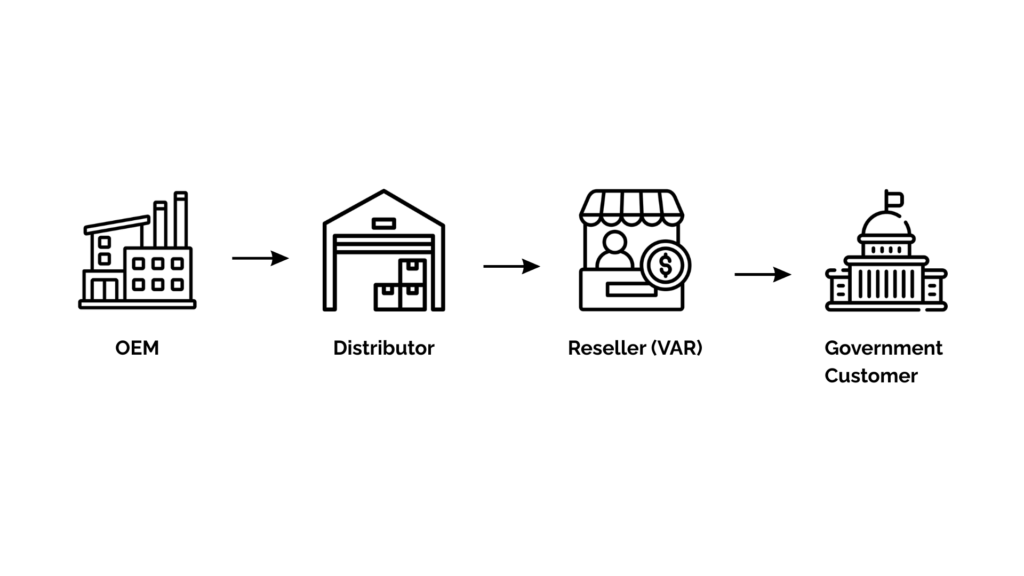
Understanding these relationship dynamics is crucial because your position in the supply chain determines your teaming strategy, pricing structure, and proposal approach.
Manually reading through hundreds of pages of solicitation docs can make identifying OEM mentions a time-consuming task.
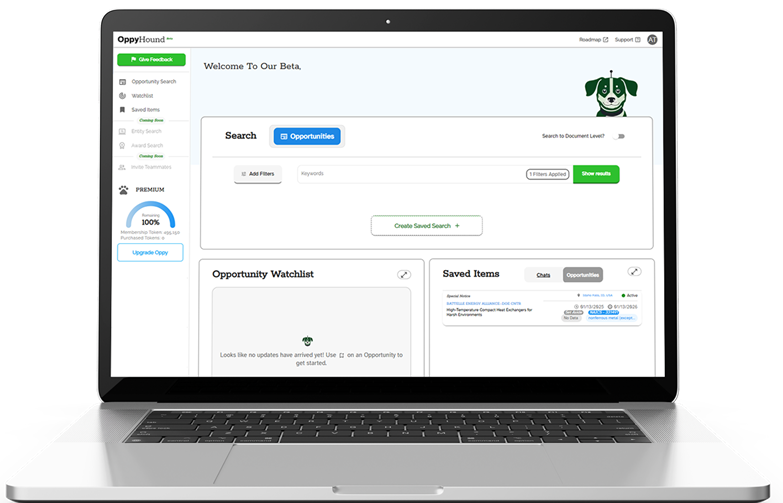
That’s where OppyHound AI-powered platform becomes invaluable.
With OppyHound’s Deep Dive feature, contractors can:
This allows your team to determine whether OEM partnerships are mandatory and plan your sourcing strategy early in the proposal process.
Building relationships with the right OEMs can significantly strengthen your position in the federal marketplace. Here are five steps to connect with OEMs for federal contracts:
Use OppyHound’s keyword searchfor solicitations mentioning “OEM,” “manufacturer authorized,” or specific brand names.
Check manufacturer certifications, warranty policies, and past federal performance via USAspending.gov or FPDS.
Reach out to OEM before RFP release dates. Early alignment ensures you can access technical documentation, reseller authorizations, and pricing support.
Many OEMs collaborate with small businesses for 8(a), HUBZone, SDVOSB or WOSB participation, helping both sides meet eligibility and diversity goals.
While OEM partnerships offer significant advantages, contractors often face several challenges.
| Challenge | Impact | Solution |
| Limited OEM Access for Small Businesse | Difficult to get authorized reseller status | Build relationships early and highlight socio-economic certifications |
| Pricing Constraint | OEMs may have fixed price lists or high minimum order quantities | Negotiate through master distributors or teaming partners |
| Documentation Gaps | Missing technical specs or compliance letters | Use OppyHound’s AI Document Chat to extract and track OEM references across files |
By anticipating these challenges and implementing strategic solutions, contractors can build more effective OEM partnerships that strengthen rather than complicate their federal contracting efforts.
OEMs are more than suppliers; they’re strategic partners in the federal contracting ecosystem. Understanding how OEMs influence solicitation requirements and how to align with them can significantly boost your proposal credibility and win potential.
OppyHound helps contractors identify OEM mentions and analyze technical requirements in one platform.
Start your free trial today to discover OEM-linked opportunities faster and bid smarter in the GovCon market.