Did you know set-aside programs make the federal government reserve over $178 billion in contracting opportunities exclusively for small businesses each year? That’s right; the government must allocate 23% of its contracting budget specifically for small businesses.
Set aside programs for minorities, women-owned businesses, and service-disabled veterans create pathways to access federal marketplace. The government targets 5% for Small Disadvantaged Businesses (8(a)), 5% for Women-Owned Small Businesses (WOSB), 3% for Service-Disabled Veteran-Owned Small Businesses (SDVOSB), and 3% for HUBZone businesses.
Furthermore, significant changes took effect on October 1, 2025, with new thresholds set at $8.5 million for manufacturing and $5 million for other industries. However, many qualified businesses have missed these opportunities simply because they did not fully understand how to navigate the system effectively.
This guide will walk you through everything you need to know about SBA set aside programs in 2026, from qualification requirements to application processes, ensuring you’re positioned to compete for your share of these lucrative contracts.
Set-aside programs are federal contracts exclusively reserved for small businesses to compete without the pressure of facing larger corporations. These programs serve as a cornerstone of federal procurement policy, designed to ensure small businesses get their share.
Small businesses often struggle to secure government contracts when competing against industry giants with vastly greater resources. Set-aside programs address this imbalance by reserving specific contracts solely for small business participation.
Every federal government purchase between the micro-purchase threshold ($15K) and the simplified acquisition threshold ($35K)) is automatically set aside for small businesses, provided at least two companies can provide the product or service at a fair price. This rule creates a protected space where small businesses can build crucial relationships with federal agencies while establishing a track record of successful contract fulfillment.
Moreover, these programs offer a vital entry point for businesses that might otherwise be excluded from lucrative government opportunities. Rather than being overshadowed by large corporations, small businesses can showcase their capabilities, expand revenue streams, and gain stability through consistent federal work.
Beyond supporting small businesses generally, set-aside programs actively promote economic inclusion through targeted assistance to underrepresented groups. The government has established formal goals to ensure contracts reach diverse business owners:
Through these structured goals, federal set-aside programs create meaningful opportunities for socially and economically disadvantaged individuals while simultaneously strengthening the overall small business sector.
Let’s break down the four most widely used small business certification programs :
| Program | Target Group | Key Benefit |
| WOSB/EDWOSB | Women-owned small businesses | Access to women-only set-asides, sole-source awards in select NAICS codes |
| HUBZone | Businesses in historically underutilized areas | Competitive edge in place-based contracting |
| 8(a) | Socially and economically disadvantaged businesses | 9-year program with mentoring and sole-source eligibility |
| SDVOSB | Service-disabled veteran-owned small businesses | Set-asides and prime contracting preference in defense agencies |
What it is:
Designed to help women entrepreneurs compete in industries where they’ve been historically underrepresented.
Eligibility:
Benefits:
How to Apply:
Pro Tip: Use OppyHound to filter opportunities by WOSB set-aside type and target relevant agencies.
What it is:
Incentivizes businesses located in economically distressed areas (HUBZones) to participate in federal procurement.
Eligibility:
Benefits:
How to Apply:
What it is:
Supports businesses owned by socially and economically disadvantaged individuals with long-term contracting support.
Eligibility:
Benefits:
Program Length:
9 years (4 years developmental + 5 years transitional)
How to Apply:
Apply via SBA’s Certify portal; thorough documentation required
What it is:
Supports veterans with service-connected disabilities in gaining federal contracts.
Eligibility:
Benefits:
How to Apply:
In 2025, the federal government allocates specific percentages of contracting dollars across multiple set-aside programs, each designed to support different underrepresented business categories.
Federal contracting opportunities follow specific dollar-value thresholds that determine how set-aside programs are applied. Understanding these thresholds is essential for navigating the procurement process successfully.
The MPT is the maximum value for the smallest category of federal government acquisitions, allowing purchases without competitive quotes if pricing is deemed reasonable.
As of October 1, 2025, the MPT stands at $15,000 for standard purchases (up from $10,000), with higher limits of $25,000 for U.S.-based contingency operations and $40,000 for those outside the U.S. These apply under FAR Subpart 13.2 and government buyers can directly award contracts to vendors using purchase cards (like a government-issued credit card).
These purchases enable quick procurements and often benefit small businesses that offer readily available goods or services.
For contracts valued between $15,000 and $350,000, agencies use simplified procedures, and the rules require small business set-asides exclusively if the contracting officer finds no reasonable expectations of receiving offers from at least two responsible small businesses that are competitive in terms of price, quality, and delivery.
This range often triggers the “automatic set-aside” process under the Rule of Two, designed to ensure small businesses receive their fair share of federal contracts.
When contract values exceed $350,000, the contracting officer must still set aside the acquisition for small businesses if there’s a reasonable expectation that offers will be obtained from at least two responsible small businesses and the award will be made at fair market prices. This is known as “Rule of Two.”
Importantly, for procurements above the SAT, contracting officers must first consider socioeconomic programs (8(a), HUBZone, SDVOSB, and WOSB) before general small business set-asides.
Large businesses bidding on federal contracts exceeding $750,000 (or $1.5 million for construction) must submit subcontracting plans outlining how they will meet the government’s small business subcontracting goals. These plans must include specific goals for small, disadvantaged businesses, veteran-owned small businesses, HUBZone businesses, and women-owned small businesses. Companies must demonstrate a firm commitment to meeting these goals throughout the contract term and regularly report progress through the Electronic Subcontracting Reporting System (eSRS).
Winning federal set-aside contracts requires careful preparation and understanding of the qualification process. Here’s how to position your business for success:
First, register your business in the System for Award Management (SAM.gov) to obtain a Unique Entity ID. This registration must be renewed every 365 days to remain active. The process typically takes up to 10 business days to complete. For free assistance, contact your local APEX Accelerators (formerly PTACs).
Size standards vary by industry and are based on either employee count or annual receipts. Check if your business qualifies using SBA’s size standards tool. Remember to include all affiliates when calculating your size. Your business must also be for-profit, independently owned, not nationally dominant, and physically located in the U.S.
Getting certified for specific programs
For the 8(a) program, businesses must be at least 51% owned by socially and economically disadvantaged U.S. citizens with personal net worth under $850,000. Women-Owned Small Businesses require 51% ownership by women. Service-Disabled Veteran-Owned businesses need verification through SBA’s certification program.
It is important that all small businesses respond to sources sought and requests for information (RFI). These market research tools influence potential set-aside determinations. Your response showcases your capabilities and helps agencies determine if small businesses can fulfill requirements. Always meet submission deadlines.
Common mistakes include inadequate SAM registration, misclassifying NAICS codes, and submitting weak capability statements. Also avoid overlooking compliance requirements and preparing poor proposals.
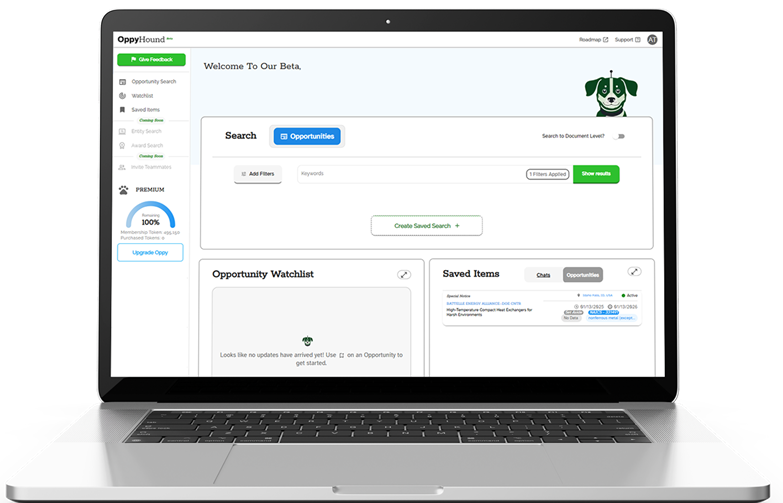
OppyHound makes it easier to discover contracts aligned with your certification. With advanced filters, real-time alerts, and AI-powered analysis, you can:
Ready to target more relevant contracts? Start your free OppyHound trial today.
The federal government reserves over $178 billion annually through set-aside programs, creating massive opportunities for qualifying small businesses to compete without facing large corporations.
With 23% of federal contracting dollars reserved for small businesses and specialized goals for underrepresented groups, these programs provide a structured pathway to federal revenue. Success requires proper certification, active registration maintenance, and strategic positioning, but the $178 billion opportunity makes the effort worthwhile for qualifying businesses.
Q1. What are set-aside programs and how do they benefit small businesses?
Set-aside programs are federal contracts reserved exclusively for small businesses to compete without facing larger corporations. They help level the playing field by allocating a portion of government spending to small businesses, providing them with opportunities to secure lucrative contracts and grow their operations.
Q2. How can a business qualify for set-aside programs?
To qualify for set-aside programs, a business must first meet the SBA size standards for its specific industry. Additionally, it needs to register in SAM.gov, obtain necessary certifications for specific programs (e.g., 8(a), WOSB, SDVOSB), and ensure it meets all eligibility criteria for the targeted set-aside category.
Q3. What are the different types of set-aside programs available?
The main types of set-aside programs include general small business set-asides, 8(a) Business Development Program for socially and economically disadvantaged individuals, Women-Owned Small Business (WOSB) program, Service-Disabled Veteran-Owned Small Business (SDVOSB) program, and the Historically Underutilized Business Zone (HUBZone) program.
Q4. How can businesses improve their chances of winning set-aside contracts?
To improve chances of winning set-aside contracts, businesses should maintain an active SAM.gov registration, respond to Sources Sought notices and RFIs, prepare strong capability statements, ensure compliance with all program requirements, and avoid common mistakes such as misclassifying NAICS codes or submitting weak proposals.